I’ve started working at an elderly living home, just in the dining room.
So far, it’s been going well, fingers crossed it stays that way. The residents like me, and my co-workers aren’t nightmares.
One thing I’ve realized, and this isn’t a new thought for m,e but it’s always reinforced by new experiences: People are the same.
Doesn’t matter how old you are, or how young.
People just want to be treated like they’re important, like they matter.
Elderly people are often crabby and unhappy… it can be annoying, but I can see why. They’re losing mobility, mental clarity, health… and friends and family.
It must be hard to be cheerful knowing that your usefulness in life is coming to a close, and much fewer people care about you when you’re not useful anymore.
I also work with children and youth often, and just last night I was having a conversation with some teens at my youth group.
I won’t go into the details, but they actually were listening to me, not because I was smart, but because I spoke to them like they were real people, like I could see theirs die, even though I didn’t always agree.
I personally hate getting written off as “too young” by people, though now that I’m getting close to 30, it won’t be a problem for much longer.
Yet, I’m mostly the same person I was at 15 that I am now, I’ve refined my style, and become more patient, more experienced with some things, but my values are the same, and so are my interests. My beliefs haven’t changed.
Essentially, I was who I was at 15, just as much as I would be at 30.
Things aren’t so complicated as we make them out to be.
I’ve never met any kid who totally changed as they aged, they might become more shy, or more bold, but part of who they are is always the same. They still wanted to be cared about.
My dad’s mom just passed away, and she was the same person, in many ways, at 90 that she was at 30.
When you work with people, you realize the key to service is caring about everyone, not to the point where you’re obsessed with people pleasing, but to see them as people with needs and wants and who could use a little more happiness in their day to day lives.
No matter who we are, we can provide that for someone else. It’s what makes the world run… All the cruel people who run our systems, and exploit everyone under them, they don’t hold the world up. They could never keep it going if not for the kind people who still go out of their way to do good.
Which is why every culture that eliminates good people collapses within 50 years. usually less.
The world will deny it, but, kind people are essential.
And if we treated each other like other people who have problems, just like we do in our own lives, and thought about that instead of brushing it off as unimportant when we’re in pain… well, we’d be a lot kinder.
It’s not a new thought. It’s not really a profound thought. It’s just true.
I can’t say anything new, as the quote goes, everything worth saying has been said (or something like that)
But I also think you can never hear (or read) this too many times. We all need the reminder everyday to focus on being kind and compassionate.
So that’s all I got today, folks, stay honest– Natasha.
I think that would probably be a pretty funny sign, would make people roll their eyes unless they appreciated my sense of humor, but hey, what else do we do with billboards anyway?
I’m glad I don’t live in the past, though it still sometimes bothers me, but it also inspires me.
I wish I could live more in the present, but, overall, like most people, I think of what’s coming.
I try not to let it consume me, but we have to make some plans, or there really is no way to go forward in life.
I do also try to keep in mind that we only have the here and now to show kindness and love to people. All our good actions happen in the present, unless they are ones that take planning and execution.
We need both really. Anyone who is realistic will admit that.
I think it’s unconditional love. I know it’s a cliche, but it’s so hard to find true love.
I have trust issues, so it’s hard for me to believe people love me. Love has also been used against me many times, and denied to me when I needed it most.
But even after all that, I still believe it exists, and I probably am more loved than I realize I am. We tend to filter out the positive when we have trauma.
Though, just saying, if someone wanted to show me unconditional love by paying all my expenses, I would be down for that.
So I’ve analyzed movies and songs on this blog, but surprisingly, I rarely ever talk about books, and I grew up being more of a reader than a watcher, we didn’t even have TV for years. [Honestly, I don’t watch TV itself now, I stream so I can pick the shows, but, who doesn’t now?]
Anyway, I still read, I try to read at least one book a month if I can, and I log the books to keep track.
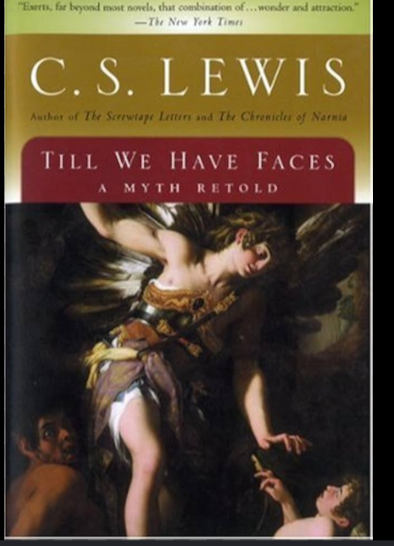
And one I read every year usually, is my all time favorite book “Till We Have Faces” by C. S. Lewis.
Lewis is my favorite author anyway, but this book is his best work of fiction in my opinion, and some other critics agree.
It’s not as novel as his space trilogy, but it’s far easier to read and had much deeper themes that are not as…theoretical as those books, (if you read them you’ll get what I mean, but I’m not talking about those ones.)
But you’re not here for me to just talk about Lewis, let’s dive into the book itself:
Plot and Concept:
In brief terms, “Till We Have Faces” is a re-telling of the myth, my favorite myth as it happens, of Psyche and Cupid, or Eros, if you prefer the correct name.
The myth itself has strong Christian undertones, considering it’s a pagan myth, as the symbolism of it is basically that our soul (which is what psyche means) must be united with Love (Cupid) to become immortal. There also a part when Cupid raises Psyche from the dead after she descends into the underworld to bring beauty to Aphrodite, the goddess who represents lustful love instead of true romantic love, or perhaps superficial love to be more accurate.
Psyche and Eros have a divine child whose name means ‘joy’ which shows how the product of the soul meeting love is Joy.
The story features two jealous sisters, so it is like a tweaked Cinderella story, but also a tweaked Beauty and the Beast. These kinds of stories run all over myths and legends across the world, makes me wonder if there was a common root that did actually happen.
Psyche is alone and unable to marry because people treat her as goddess instead of a person, so an oracle prophecies that she will marry a monster feared by both gods and man, but this turns out to be a riddle that means Cupid, since love is powerful enough to make both gods and humans do things they would normally do (and Greek myths are full of the God doing dumb things because of ‘love’).
A pretty cool story on its own, really, but Lewis’ retelling is masterful.
In Lewis’ retelling, Psyche is instead sacrificed to Ungit, the name he gives Aphrodite, the goddess who represents animal, profane love that only takes and takes and gives nothing back.
But Psyche is rescued by The West Wind god, and taken to the god of the grey mountain, who is Eros in this story.
They are wed, and she lives happy but Orual, her older sister who is uglier than any other woman in the world, finds out about it and is jealous of her, though she thinks it is not jealous.
To make a very complex story short, Orual forces Psyche, by her love, to betray the god of the mountain, and Psyche is sent into exile as punishment, while Orual is told that she “will know herself and her work, and she also shall be psyche.”
Orual is not sure what this means, and instead of being doomed, she becomes the Queen of her country, Glome, in the next week, and rules for many years, trying to bury the pain of the memories of Psyche and what the God told her.
The Conflict:
Finally, Orual hears the story of Psyche and herself retold, but in the original fashion of the real myth and it infuriates her, so she writes a book, which is the book we the audience are reading, of a complaint against the gods, putting it to us like a case to be heard, hoping that some Greek, who speak more freely of the gods that her own people, I’ll read it and judge.
After she writes the book, she begins to have mysterious visions from the gods of things happen to her, that also happen to Psyche, in the myth, only for her they are much harder and more painful.
She begins to also learn from the people around her that she’s lived her life devouring the lives of others, as she was always bitter that she was ugly and could never marry or have children, so she obsesses over a married man who she loved, and she kept her adopted father, the Fox, in Glome with her isn’t sending him home, and she abandoned her other sister Redival, in order to have Psyche all to herself. And she wanted Psyche to love her just as obsessively, instead of in a normal, healthy way.
One of the most striking moments of the book, early on, before all this, in which Psyche says to her
“You are indeed teaching me about kinds of love I did not know. It is like looking into a deep pit. I am not sure whether I like your kind better than hatred.” [Chapter 14]
Later, after seeing the visions, Orual is taken to the court of the gods and her case is read.
As she hears her own voice saying the true words of her soul, she realizes that she only ever wanted to devour Pschye’s love, to possess it all for herself, she never truly loved her unselfishly. The gods gave her chances to do so, but she rejected them all and instead blames the gods for luring Psyche away by their beauty and their goodness that she didn’t understand.
After this, she is shown all the thing Psyche suffered for her sake and then, she is taken to meet the god of the grey mountain, and Psyche also meets her and forgives her, and give her the beauty of death (but death to the profane love of Ungit, not literal death) and Orual sees her reflection changed to be beautiful, and then she hears the words: “You also are psyche.”
She then wakes up and writes in the book that she knows why the gods don’t speak to us face to face, because they can’t ’till we have faces?’ (A line that always gives me chills).
Meaning that, until we know what we really mean, and not just what we think we mean, they cannot be open with us, since we cannot be open with them.
She also writes that she knows now that the god of the mountain did not give her an answer, because he is the answer.
Christians will spot the characteristic that we assign to Jesus here, as that is the metaphor of the god.
Context:
I think you could understand this book without knowing anything about Lewis, if you have a good understanding of the idea of love, and real love versus selfish or toxic love.
However, I’ve seen many people review the book who said they did not fully understand the ending, or all the themes.
When I read it the first time, I understood it by the time I got to the end, and every time after that, when I read it, I understood it better. Especially after I read “The Four Loves” by Lewis also.
Lewis has a fictional version of pretty much all of his non-fiction books of theology and philosophy, which not a lot of people know. This book is his fictional version of “The Four Loves”, as well as some parts of “The Weight of Glory” and “Mere Christianity.”
You can find some of this in his fictional book “The Great Divorce,” but this book is his magnum opus of writing about love, so I always refer back to it the most.
To understand the ending of the book, as well as the conflict you need to know the Lewis believed that true love, charity or agape, as he called it (the Greek word for unselfish, unconditional love is agape) was the holy kind that has to come into every other kind of love to make it good.
And the human love, which is ‘need’ love’, he says, will become devilish, if left to itself.
He give examples of such, how things like affection (family love, also called storge), can keep people under the control of their family if they are left to themselves; how friendship love (phileo) can be snobbish and exclusive and also corrupt people because it puts the friendship above doing the right thing; and how romantic love (eros) can corrupt people even more by being so exciting that it makes them do things like cheat, lie, and steal, all in the name of love.
And some people are even cruel to the one they love, because they think love makes it okay.
In each case, he points out that the love doesn’t have to be evil, but when all other things are put aside, all moral and rational limitations to it, then all loves becomes evil.
Agape love can’t be evil because the basis of it is that it loves you freely, it doesn’t ask for anything back, it doesn’t need anything from you, and it doesn’t demand you do what it wants. It’s love free from the temptation to be possessive.
Obviously, he points out, no human being can perfectly live in that state of love at all times.
It’s not necessarily bad, to need each other. As in this life, we will need each other, and most people like to feel needed. Being completely independent of people is more selfish than needing them a little bit is.
But when that need becomes all we can think of, and we can never put it aside even if it’s hurting the other person, then the love is demonic. Or profane, as some people put it.
Now we usually say toxic. I like profane better.
Toxic love can be negligent in a relationship, if it’s not too big a part of it. We like to joke these days about toxic traits, but most toxic traits, in small amounts, won’t ruin a relationship. If the other person understands you and is willing to overlook, and you do the same for them, then it won’t really matter in the long run, though you should definitely still try to improve.
But profane love is where there is nothing but that. Toxic love that has poisoned the entire relationship, the kind narcissistic people have. They cannot ever love you with anything but that kind of love.
Even when they act like they’re doing something unselfish, they expect you to pay them back for it in some way.
To me, this book was life changing. I read “The Four Loves” I think after I had read this book, but when I went back and re-read it, I saw how brilliantly Lewis wove the themes of those principles in the story.
Orual, once you know how to look for it, is a huge example of profane love. Yet she’s not hateable. She had good points– he still made her believably human.
Her ugliness, which I saw complained about by some readers, is symbolic. It’s meant to show how her love is ugly and profane as her face is, and when she is freed from that love, she is freed form her ugliness also, at least, spiritually.
There are also other favorite themes of Lewis in the book, such as how important reason is, represented by the Fox’s character who is a Greek Philosophy lover.
Also some very sharp insights into how cruel men are often hiding insecurities, and bitter women are hiding jealously.
Not that it can’t go both ways, it can, and it does, sometimes.
There are also ideas of sin, and repentance in there. As Orual must die before she dies to escape Ungit, who represents carnal sin and love, and it’s said that even Psyche, who was a nearly perfect human, had to die and escape her as well. How they have to gather the beauty of the gods without effort, because no effort of theirs could get it, and how we have to resist temptation to give into the pressures other people put on us, even when we love them, if it means disobeying God, because God comes first.
Lewis goes into more detail on these themes in “The Four Loves”, but the book portrays this so poignantly, that it’s impossible not to see yourself in some of what Orual says and does.
Personal Impact:
I’m not kidding when I say that this book changed my life. I read it maybe a few months to a year after I became a Christian, and my relationship with my family was still a wreck at that point.
A lot of that was my dad’s fault, I certainly saw him in the abusive father in the book, but, the book showed me the things that I did and said that were like my dad, and things that weren’t like him, but they were still wrong. It made me see my relationship with God differently also.
C. S Lewis believed that we can never see ourselves clearly, or our sin, that we can never be fully aware of how bad it is, or how good God is, but only see dimly. This is probably true, as the Bible says similar things.
That idea helped me to be more humble when I prayed, not always, and I’m not always now, but at least I had the concept fully rooted in my mind that I could never fully know myself enough to know if God was wrong to do as He did. Also to question my motives for things whenever I started whining about not being treated fairly; sure sometimes, it’s valid to say you deserve better; but you have to watch to make sure yours not demanding something just because you want it, and not because it would be best.
The book didn’t make me neglect my own well being, as some people say Christianity teaches people to do, if anything I think it helps me understand why my father was wrong and I needed to cut ties with him as an adult. Other teachings I heard sometimes made me think I needed to put up with his abuse, but not this book.
It also always reminded me that the answers in God are often found more just by knowing him more than by mere logic. Not that logic isn’t good, Lewis loved logic and reason, but often we find it’s limited, since we are humans, and everything we do is limited. Sometimes you have to go beyond just pure reason to understand things.
Criticisms:
People have accused this book of being sexist because of the many things Orual says against women and as an ugly woman.
I think that’s because they don’t read Lewis’ other books. Lewis was not sexist (at least not for his era) and he had many women students and married a woman who he admitted often won arguments with him very easily. He actually liked that about her (and he dedicated this book to her, in fact, since she held him come up with concept).
He puts himself into the mindset of a bitter woman so well I’m often shocked when I read it, as mostly when male authors try to write how women feel, they fail miserably, in my experience, because they think of it as a woman instead of person.
As a woman, I could relate to Orual, though I’m not ugly, but as someone with a bad father, and who’s been rejected often for reasons beyond my control, I could still identify with her bitterness and sadness.
As well as her wish to assuage that by grabbing at whatever she could.
I don’t find this sexist. Men do it as well, and men can see themselves in this book just as easily as a woman can. The remarks Orual makes about women are from her own bitterness, and made because the character narrates the book, they are not Lewis’ actual opinion on things.
He was very good at making even characters who disagreed with him feel real and if you read his other books all of his characters feel like real people you could meet, except the ones who are sometimes wiser and more noble than humans usually are.
The other complaint is the themes are hard to understand.
Well, they can be. They were not as hard when he wrote it, more people had read the myth, and more people were writing other works with similar themes at the time.
I think it was still very complex, even then, but to our barely literate culture now, it is hard to understand.
That said, it’s still an easy read, full of fun language that’s not too old fashioned for most fantasy lovers to read, and fun characters.
I don’t recommend letting a child read it since it talks about sex more openly than his other books do, but he didn’t write it to be a children’s book.
I would say though, any child 12 and up could probably handle this book, since it’s not too explicit and that’s the age most kids start being more self aware about how they act, so that’s when it would help to read books like this.
I was about 14 when I read it the first time, and I understood it, but I was very literate for my age, so if parents are going to let their child read this, I’d say to use your own discretion.
Closing thoughts:
There are not many books like “Till We Have Faces” anymore. It’s a level of parody and fantasy writing that most authors just can’t achieve in the modern era, because they haven’t read enough books like it.
Its deep themes are timeless, and everyday problems, not ones that only intellectuals would care about.
The ideas of love within family and romantic relationships are ones we all can learn from, as well as how we isolate ourselves in our own minds, when we’re bitter and angry about our lot in life.
So I recommend reading it even if it’s not your usual thing.
You can find an audio book version if reading isn’t your thing, and I recommend doing that, because this book is too good to miss if you like fiction and especially if you like myths and symbolism.
I’d like to close with a few more memorable quotes:
“Don’t you think the things people are most ashamed of are the things they can’t help.”– Psyche.
“You must die before you die,”– the god.
“Who can feel ugly when the heart meets delight?”– Orual
“And in that far distant day when the gods become wholly beautiful, or we at last are shown how beautiful they always were, this will happen more and more. For mortals, you see, will become more and more jealous. And mother and wife and child and friend will all be in league to keep a soul from being united with the Divine Nature.”– The Fox
My basic views have never changed that much, since they were based on strong principles of my faith, which I’ve also never changed, though I have questioned it.
I am more open to thinking there is more than one right way to do things for a country, as long as some basic principles are always adhered to.
Like one side thinks one solution works, the other has a different one, maybe either could work if done the right way.
I do have a problem with hypocrisy though, if people on any political spectrum say one thing, but do another, or only try to help one group, but ignore another, then I think it’s wrong.
I have become a bit more centrist I think than my parents, but, not enough to really cause conflict. My conflict is with extremists in any group, not with the rational minded people in them who can compromise.
If that answers the prompt, I’m not sure, it’s kind of a tough one for me.




 drybonestruth