I looked at my Home Page post today, I hadn’t updated it in ages, boy, it was rough. Now that I’m used to blogging, I feel it was too rigid.
But it’s a great reminder how I didn’t know what I was doing 5 years ago, almost, and now I do–sort of.
In many ways I’m still an amateur who doesn’t know how to market themselves, but I have a blast writing this anyway. And thank you for reading it.
Between shifting family dynamics and shifting cool perceptions, this past year has not gone as I expected.
You know what I have discovered? A lot of people don’t put in effort to understanding each other.
Shocking, I know.
Seriously, though, I am that semi-rare individual who studies people around me constantly and I have done it for as long as I can remember. My mom even confirmed that I did it as a toddler. It’s in the genes, I guess.
Not sure whose, neither of my parents are like that.
I realized I am something called an Empath.
“An empath is someone who is highly aware of the emotions of those around them, to the point of feeling those emotions themselves. Empaths see the world differently than other people; they’re keenly aware of others, their pain points, and what they need emotionally.
But it’s not just emotions. According to Dr. Judith Orloff, author of The Empath’s Survival Guide, empaths can feel physical pain, too — and can often sense someone’s intentions or where they’re coming from. In other words, empaths seem to pick up on many of the lived experience of those around them.” (Andre Solo. 13 Signs that you’re an Empath. Link here: https://highlysensitiverefuge.com/empath-signs/)
1. You take on other peoples’ emotions as your own
Turns out the feeling I get when other people come in a room, like I am feeling their energy and emotions, is something empaths tend to feel. That’s number one on this list.
6. Tragic or violent events on TV can completely incapacitate you
So, it’s also why I hate scary and tragic stories, it’s never just a story for me.
Poor baby.😢
Freaking why?!!!😠😣 (Not the ship, the afterward.)
(I love both shows, by the way.)
Also, apparently, I can tell when people are lying(No#10.).
Being an empath is also the reason why I am an introvert. I don’t need alone time because conversation and activity drains me, people drain me because I pick up on all their energy and emotions(No#2 and 3).
It is as natural as breathing to me to do this, it blows my mind that other people do not walk around constantly noticing this stuff.
Oh, yeah, right, that’s why.
Every little change of expression and voice come across to me.
Another sign mentioned in the post is being able to feel pain and even sickness(No#8).
I’ve talked about this before, but all the way up to my tweens, I would feel sick after reading about sickness, or feel pain after reading about an injury. Hypochondria, in other words.
It used to scare me, it no longer does, but there are times when I still feel it, even if I don’t think I have it.
Now imagine this, having a confrontation with someone, only you can feel their anger, sadness, and frustration as well as your own, the entire time…
“I can feel your anger…” (Not an empath, just to be clear.)
Some of you who have a hard enough time dealing with your own want to curl up into a ball at the mere thought of that.
That’s my life. I’m Natasha, Nice to meet you.
And yeah, if anyone is every BS-ing me, I can tell pretty quickly.
I never used to believe my impressions of people, I thought I was just mistrusting…and I can be. But I am very often on point to a degree that amazes my family.
This even works with fiction. I can predict show plot points very easily. I pick up on patterns of characters. and the author, based on what they feel and how they act when they feel that way.
You may have see reviews that over analyzed every detail of something, that’s me.
However, though I have experienced all 13 of the signs of being an empath at some time in my life, I do not deal with all of them all the time, anymore.
I realized I could not take that pressure. It’s easy for me to compulsively take care of people, but I still have feelings of my own that I have to divide from everyone else’s.
The reason I want to share that with you here is that all of us, obviously, have a personality type.
But you are not limited to your type.
I am an empath, I will always pick up on what people feel, but I have grown much stronger at rejecting negative feelings when they are not my own, and positive ones, when they are false. I will feel their pain but I do not have to carry it.
Suck it, Pain. You think you’ve got it bad.
It could be easy for me to be a sucker. What’s an annoying sob story or pep talk to you becomes a barrage of emotions flung at me, and if the person believes it, I can tell.
And if they are wrong, I have to consciously choose to reject what they said.
If you wonder how this can be dangerous, then think bout this, I come form a background of having an Emotionally Abusive Parent.
The delusions of emotionally abusive people is that they often think they are right. Emotions are tricky like that.
Even when my dad knew he was wrong, he used my emotions against him. He could tell when I was weakening, and he’d latch onto it.
This man liked to tell me, when I came to apologize for some stupid fight that he usually started, that he was going to give up on trying with me.
I would feel his pain, yet, I also would feel his intention to make me feel bad, and get furious.
It was not fully fake but it was never honest.
Take that, multiply it by dozens of incidents over the years that I’ve lost count of, and you have a really bad set up.
You might think as an empath that I am easily offended…
…but as this blog and the book it was talking about point out, not all empaths are HSP (highly sensitive people).
I was once, but I am no longer very easy to offend.
In fact, instead of being weaker emotionally, I am actually stronger emotionally than many people. My ability to process other people’s emotions and my own at the same time has made me stronger, because I have to hold both.
And I had to learn to let stuff go, otherwise it would always weigh me down.
I have evidence that the empath ability starts at birth, as even as a baby I reacted poorly to people who were stressed or angry.
Empaths aren’t really easy to explain with science. Unless you believe in mind reading (and you’d be surprised at the evidence that mind reading is actually somewhat possible, though not like in sci-fi, where it’s conscious concrete thoughts) how will you explain that we can actually feel feelings and read people so accurately.
But there is, as always, a biblical; explanation where science has not yet reached(though it’s getting close.)
In the bible there is a gift of the spirit known as Discernment.
Someone with this gift can tell truth from lies, and one emotion from another, and make sense of it.
Discernment is dangerous without wisdom.
I can attest that empaths who do not have wisdom can end up very unhappy and make the people around them miserable. Also, we tend to get asked for advice, and if our priorities are not straight, we aren’t going to give it well.
Discernment is gift from God, but you can have it without knowing God, just like with other talents. People who do can end up in a world of hurt.
But walking with God and letting him refine and hone my gift, I have enjoyed it a lot for the most part.
God helps me avoid pitfalls, as I can’t always be right. Where my gift comes short, He will provide an answer.
Being an empath enables me to be interested in a lot of people, and to always have new things to notice about them.
If you were to ask me, after all this, what the hardest part about being an empath for me (as it is like a job in many ways, to monitor all the people around you without even wanting to) is, I would say this:
Trusting yourself.
When you know what everyone feels, deciding what you feel is right, is hard. Sometimes they can be so passionate, and yet over the wrong thing, that it’s hard to say no.
You doubt whether you made the right choice, because you can sense their disappointment or anger.
But if you keep giving yourself enough credit for when you are right, it gets easier.
I am at the point now where I can stick to my guns even if I know someone is getting upset with me. I just have to choose to think that what is right is more important that if they get upset.
And that’s an interesting thought. Because many people now say that what people feel is more important than what’s right, empaths might be more likely to buy into that, yet here I am, saying I don’t.
Which is why I say, your type does not control you. You are still a person with free will. Whatever your natural inclination are, you can choose better, if you know that there is a better.
Learn to make your type work for you, don’t let it drag you by your hair, if you have hair.
And that is all for this post, stay honest–Natasha.
I am taking a Philosophy Critical Thinking Class for the Winter. Which means I have it for three hours a day for three days, 9 hrs a week. For 6 weeks.
That’s around 36 hours.
It’s been one week, and I’m already so freaking done with this curriculum.
The class itself is fun, I’m in Honors, so the smart people are in this class, the ones who can follow what I’m saying half the time in discussion.
But the textbook–ergh! I’m in chapter one and its already so, so dumb.
Plus, the reading materials we’re given. Is it too much to ask that they not all be leftist, liberal, progressive, and invariably biased.
I know, I know, Public College has to push the liberal agenda, but why not just pick subjects where there’s not as much of a clear bias to have us read about, this is social conditioning, not critical thinking.
(I wonder how many people would go to that class, if they offered it, because they don’t know what Social Conditioning is and think it’s a real subject.–I mean it is, if you’re part of a regime…or the school system.)
On top of that, Philosophy is taught a certain way now that is just ludicrous.
You’ve no doubt hear it before. The Relativistic approach.
I’m supposed to be practicing defining terms for my papers, so I’ll go ahead a define a few here:
Relativism: any theory holding that criteria of judgment are relative, varying with individuals and their environments. (Webster’s.)
Philosophy: the rational investigation of the truths and principles of being, knowledge, or conduct.
the critical study of the basic principles and concepts of a particular branch of knowledge, especially with a view to improving or reconstituting them:the philosophy of science.
a system of principles for guidance in practical affairs.
The Greek words that the word Philosophy comes from are Philo and Soph, that is, Love and Wisdom. Philosophy initially meant the “love of wisdom.”
When you read the older philosophers, like Socrates and Plato, you’ll notice they really enjoyed what they were talking about, they enjoyed seeking the wisest, most right course of action.
In modern times, people are trying to redefine Philosophy to mean its inverse, Not seeking Wisdom, not seeking truth, but treating all ideas as equally valid. Antisophy, if you will.
It should be obvious that Relativism and Philosophy are actually polar opposites. Who can love anything relatively? Certainly not wisdom. Love is passion, not a mediocre feeling of approval.
Yet, in my philosophy class about critical thinking, I am told that certainty in our knowledge is a “potentially dangerous mental bias”, and that the goal of critical thinking is to be relativistic. To commit to the pursuit of knowledge, for its own sake, and not to any one way of looking at truth.
Why the heck I should care about truth, if knowledge is impossible to be certain about, is not explained.
Think about it: If we cannot be certain of knowledge, i. e. Truth, then Truth is not real. Therefore, what is the aim, the end goal, of critical thinking?
To discover that one non-truth is preferable to another non-truth?
As long as I don’t believe in Theism and Right and Wrong, by any chance, the Philosophy Course doesn’t really care to answer that question.
I am not kidding when I say the chart we were given to evaluate our level of critical thinking was intentionally trying to shame religious people be putting the belief in a religion and good and evil as the lowestform of thinking a college student can begin from.
(If you don’t believe me, look up Perry’s Scheme, and see for yourself. Here’s a chart of the basic ideas.)
The book we’re reading is going a bit further, even, down this Rabbit Hole. Here’s a direct quote from chapter one, the chapter that sets the tone for the whole book:
“But once we acknowledge that our commitments are based on probability and not certainty, we will be much more open to the reasoning of those who are trying to persuade us to change our minds. After all we may well be wrong about some of our beliefs. We have to listen respectfully to those with whom we may disagree. They just may be right.” (emphasis mine)
In literally the next paragraph this enlightened author then says:
“There will seldom be a position on a social controversy about you will be able to say ‘this is clearly therightposition on the issue.’ If such certainty were possible, reasonable people would not be debating the issue.” (Emphasis still mine.)
(If you want to see for yourself, the book is “Asking the Right Questions: A guide to critical thinking” by M. Neil Browne and Stuart M. Keeley.)
Yes, students, your opponent maybe be right, but there is no clearly right position for them to be right about…cause that makes sense, in this critical thinking book.
I pointed out to my professor the hypocrisy of someone stating that certainty is a dangerous state of mind with such certainty… She wasn’t amused.😐😐😑
She also said that there is no such thing as “Moral Objectivity”, to which I asked “Are you certain about that?” She looked at me for a split second like “so…we’re doing this” and then said “No, all things change.”
Well, okay, glad we’re clear on that.👍
To do her justice, I do not think my professor is trying to indoctrinate us on purpose. She seems like a nice lady who didn’t even get too irritated at me for calling her out. But she’s still teaching irresponsibly if she does not acknowledge what are clear and oblivious hypocrisies in the philosophy of the people we’re reading.
And this book is full of it just in the first chapter, which she also does not acknowledge.
What’s disturbing about this book is that on the next page, it states that critical thinking can be humane and progressive, if it is not used as a weapon.
Critical thinking is a weapons, no matter how you use it, you are trying to clear certain fallacies and ideas out of your way to make room for the good stuff.
Also, no form of reasoning is inherently humane, Reason is Reason. It’s measuring, assessing, analyzing, it’s neither kind nor cruel.
One might reason that it is better to stick to the old thing than to a new thing. Reason is not inherently progressive. Whatever these guys even mean by that, they don’t specify.
All this tells me is that this is intentional.
It’s silly to pretend it could not be intentional.
Browne and Keeley are deliberately trying to shame students who they suspect hold different values from them into feeling stupid, and accepting their beliefs.
The student is told in a polite, concerned tone that we should listen to other beliefs, but this is not demonstrated, because they authors do not bother to consider the notion that there may actually be a higher truth, they just throw that out immediately. Therefore making an assumption that they do not test their own form of critical thinking on.
It’s condescending as heck, and it’s brainwashing. I normally hesitate to accuse people of doing this deliberately, but there’s just no way so many blatant instances could occur withing two pages, if it was not intentional.
That being said, the inconsistency within their own thinking is rather impressive, as within my professor’s, and the other articles we’ve been reading.
I know what it is, they are muddled, because that is easier.
If you treat truth as real, and clear, and teach people how to pursue it, you run into the uncomfortable fact that truth has to be true for a reason. There has to be something behind it, or it would not be true. Like a prize on a show where you have to choose between different doors.
That Something behind Truth might just be something more powerful than us, something we might have to take into consideration when we make decisions.
What’s funny is that not everyone who rejects the idea of a Divine standard is living an immoral life, it’s simply that they don’t want to be controlled, even if being controlled would only mean they had to do the right thing, which they claim to care about.
Some people say they don’t need God to lead a moral life, they can just decided to themselves without some Great Power telling them what to do.
These people do not understand what God is, if they believe that they could even have an idea of what is right, without Him. What standard would they go by? What else could make sense bu that God put certain rules in place in the universe.
Personally, I do not find believing in God to be limiting. Believing in a God who has no limits means that I have far fewer limits than I would otherwise have. The person who does not believe in God thinks flying is impossible without technology, the person who believes in God only thinks flying is improbable, it is not impossible. (Some mystics were said to have floated.)
Believing in God allows me to see good in almost everything, even if I mostly disagree with it, and allows me to judge anything as having flaws, if it does. I do not have to pretend.
While I can allow for some good in this stupid Philosophy Course, it cannot got the other way, The Philosophy Course can not allow for any validity in my perspective.
Those who believe God is truth can love truth, and love pursuing it, even if the path to it is through cold logic and not directly acknowledging God.
But those who believe truth is not certain cannot allow for anyone or anything that would make it certain, therefore they exclude any valid reasoning on a Christian’s part.
If it is not so, then why do they not include religious based arguments int hes classes, what are they do afraid of? If all views are equal, why is a religious view also not equal?
These are questions you won’t see addressed in college.
One thing I said in that post was that: “Resurrection means restoration.”
I’ve been thinking since finishing that too-oft-named Anime, Naruto, that Restoration is actually a big part of anime, and other shows too.
Also, it’s not just fiction, G. K. Chesterton said that:
“In history there is no Revolution that is not a Restoration... all the men in history who have really done anything with the future have had their eyes fixed upon the past.”
Restoration, it’s used a lot in Church, many people might just associate the word with what you do to an old building, or an original version of a movie. (My mom wishes they’d restore the original Star Wars movies to the pre-CGI versions.)
Here’s a dictionary.com definition of Restoration:
noun
1.the act of restoring; renewal, revival, or re-establishment.
2. the state or fact of being restored.
3.a return of something to a former, original, normal, or unimpaired condition.
4.restitution of something taken away or lost.
5. something that is restored, as by renovating.
Renewal, revival, reestablishing.
If you go by what Christianity, and a myriad of other religions, teaches, then anything Mankind does right would have to be a return to its original state.
Deep down, human beings feel this longing to return to former glory, sometimes we call it Nostalgia. A wish to return to innocence. Innocence is glory.
We also feel a desire for new things, but new things tend to be just old things in a different form.
All Revolution calls for a new thing, but an honest look at the past would reveal that the new thing is something people did long ago.
The American Government was supposedly new, but it was based on both Roman and Hebrew systems, one found in the Bible quite clearly. The Biblical Law was one of the earliest known to not have a king or ruler in charge of the people. Until they demanded it later. (A tale as old as the hills, historically speaking.)
Chesterton also had the thought that Human Beings, have grown older than God our Father, we grow tired of doing the same things, and that is why we have to package Goodness into so many new forms. We don’t like to play the same game, hear the same song, over and over again without a new change of pace.
But it is possible God does not get tired of Good Things. And those things are, in the end, what we keep coming back to.
In the Bible, when someone strays from the path then turns from their wicked ways, it is always called a Return.
Notably, in fiction there’s a common thread that the way to fix things is to go back to a state of being. In Modern Fiction, the Ideal tends to be a normal human society, not a robot, or communist, or barbaric society. While in older fiction, the ideal was more likely to be a heavenly society of some sort, something higher and purer than just ordinary people’s interactions.
We’ve all seen the story-lines where the MC has to return some special item to some spot, and that will restore the land, the proper power, the true heir to the throne, etc. Sometimes the item has to be destroyed to restore because it is cursed.
Whether the answer is destroying or returning, the end result is always a restoration.
Can you think of happy ending that did not include a Restoration? Go ahead, try, I’ll wait…
Anime is rife with this theme of Restoration. Usually it is through defeating the Big Bad at the end of the arc, and the land will magically heal. I watched the Naruto Movie: TheStone of Gelel today (It had the best boys in it, so I thought why not?), and it had the same thing, the trope where the land is healed all at once.
The Lion King has it too, though its over several months in that one.
I know I have readers from outside America, I may not know them, but you’ve definitely already got stories in mind that end this way. Every culture does.
In fact, it’s been noted that there is really only one basic plot in writing, even in nonfiction writing.
A problem is introduced, and a way to fix it, to restore us back to some ideal.
C. S. Lewis’s Pilgrim’s Regress is actually based entirely on the idea that any goingforward, morally, is a going back. In it John, the Pilgrim, travels his land in search of an Island that ends up being the back of a mountain by his home. He comes full circle.
That is what the Eastern idea of Cyclical time is really about, that everything returns to its initial state, (we just disagree about what that state is.)
The important thing to understanding what the Restoration was is to keep in mind it can be either a symbolic physical act in the story, or it can be an emotional restoration, even a spiritual one.
Some stories will have a healing, where someone will have a physical problem fixed. Breaking Curses, undoing creepy science experiments, remedying a plague, all that falls under this category.
Other times the restoration will com in the form of finding a family member, finding a homeland, finding a title or position.
It’s more widespread for it to be an emotional restoration. From romances to kids shows, that restoration has to happen. Someone finds true love, remembers what’s important, learns what it is like to be human, learns the power of a certain virtue. And it restores them to who they are meant to be. Often who they once were, at the beginning of the tale, before the bad events took it from them.
Isn’t that what we all want in our lives, some of us want to be abletowant it again.
All of us have an idea of a good life that we once had, or could have had, and we feel we missed it.
We’ve been told that the good life is in the present, yet we want to go back still. Be young again, be married again, have kids again, have that job again, like that thing again.
“Like constellations imploding in the night; everything is turning, everything is turning, And the shapes that you drew may change beneath a different light, and everything you thought you knew will fall apart, but you’ll be all right“–The OH HELLOS, Constellations.
Today is the last day of 2019, how often have we thought that this year? Or in previous year’s. Maybe we had a good year, but even in happiness there is often a nostalgic feeling, at least for me. Like “Ah yes, this is how I used to feel.”
But when I was a kid, I wasn’t often happy. The nostalgia is an illusion. I am really wanting to go back even further. To a different time, one before I was even born.
But those ages had trouble too. I’ve read enough to know they felt the same.
We have to go back further still, before the Fall.
Stories communicate that in their own way, by settling on one disaster that really changed it all for the worse, and must be undone. On Naruto, it was the battle of two friends, and two brothers, that begun the whole freaking mess. Supposedly it is undone by Naruto and Sasuke coming to peace. Rather like Cain and Abel.
In real life, people rarely narrow it down to one thing that’s wrong with the world–or their lives. You could list a half a dozen right now, if I asked.
As Rich Mullins sang “Everybody’s always saying they need just one thing, but what they really mean is they need just one thing more.”
In stories, a value like love, friendship, courage, or honor, tends to be the One Thing we MUST NOT LOSE EVER, AT ALL COSTS.
I’d like more things to be good in the world, and my life, sure. But I’m with Mullins. God is my One Thing.
To wrap this up, I guess my final point is that at the end of the year, the end of the story, the real question is: What is that One thing you need restored to you? Or maybe you need to be restored to it.
To find a new thing is to find an old thing.
Well, I hope you enjoyed this send-off post, it’s been an interesting year for me, and I wish you the best in 2020. Happy New Year everyone⌚⌛☺–until then, Natasha.
This is just an anime fan post, so I don’t expect that many people to read it, but there is one thing I’d like to discuss that applies in real life to everybody.
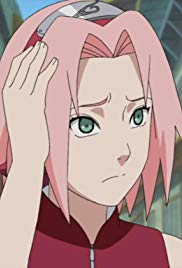
Sakura, if you don’t know, is one of the Main Characters of Naruto. She has the privilege of being one of the mosthatedcharacters in popular anime that I know of.
I’m here to look at the question honestly: Does Sakura really deserve it?
I’m going to make the case that Sakura as a character does indeed deserve to be hated, but it’s for a reason almost no one talks about, and it’s not the reason she gets dumped on by the fans the most for.
The charges leveled against Sakura are as follows:
She never does anything.
She never does anything and is useless
She never does anything and is annoying
She never does anything but smack Naruto around
…..Uh…what other character traits does she have?
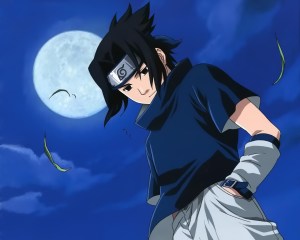
Oh, yeah, being obsessed with Sasuke. The hands-down worst person on the show.
You get the idea.
According to my sister, the author himself was puzzled by the fan-hate toward Sakura after the initial seasons of the show were released, and decided to give her more things to do. Allegedly.
But his idea of fixing the problem was having Sakura begin hating on herself for being helpless, making a couple attempts to defend herself that ultimately ended in her still needing to be rescued; become a medical ninja, but still staying out of any plot relevant battles until the final season; and going from hating Naruto to loving but still treating him unfairly.
Sakura annoyed me and I usually try to like female leads. The females tend to bring more skills I can relate to to the table, like book knowledge, science, or emotional intelligence.
When Sakura was pitched to the audience, via the teachers, as a smarter character, I was down for that. I don’t think all team members need to be boss fighters to be cool. S
However, Sakura is not very helpful in the intelligence department. She has a few moments here and there, but I can’t say she ever came up with a plan, or did more than give a few helpful tips.
So, the tech support role was out for her. (She might have done better in a show with more technology based battles.)
The next option is usually emotional intelligence. The character who keeps everyone at peace and sane.
The show pitched Sakura as this also, but she has a short temper and is not paitent, so the role never really took hold.
It felt like Kishimoto was trying to figure out what the heck to do with her, and kept trying one plan after another
.
Finally, he had as stroke of genius–at least he clearly thought so–why not the healer? Everyone loves the healer characters!
Give Sakura some cool life-saving moments through medical science, and people will finally quite hating on her, right?
Wrong.
As a professed fan and analyst of sorts, I recognize what my sister refers to as “illogical salt” when I see it.
I have to say, I never liked Sakura except briefly in Shippunden between major plot point, but dang it, if I’m going to bear with her for the whole show, I’m not gonna hate on every little thing she does.
Since I’m taking a honest look at he character, it’s only fair to say she doesn’t deserve a lot of the hate she gets for the reasons I mentioned above.
An all fairness, Sakura is not useless. That charge is the biggest one, and one I said myself without even knowing it was what everyone else said, back in season 1 of the OG show. (Yeah, I’m not one of those people who states things other fans have said as if it’s my original idea, I just pick up on patterns really quickly.)
Sakura was useless a lot, but I don’t discount small contributions. Since I tend to like characters who get less screen time anyway, I’ve learned to appreciate little gestures, and my guess is Sakura’s supporters (there are a surprising amount) are the same kind of fans. There’s traits that come with characters who don’t get attention as much, and if you prefer those, you’ll prefer those characters, it’s just how it works.
One such fan commented under one of the episodes a lengthy defense of Sakura, I shortened it for this post and took out some rude jabs at the haters:
“.. have you forgotten she’s also a part of team 7 or team kakashi? have you forgotten that she stood up to those sound village ninjas when naruto and sasuke were passed tf out? have you forgotten that she herself dislikes how useless she’s been and therefore trained hard to be a medical ninja so that she can also be of use and not just stand in the way? have you forgotten that sasuke also considered her as a friend which is why he said “thank you” to her as a parting gift? have you forgotten that she’s long grown since hating on naruto and finding him annoying to actually admiring and caring for him?… like she isn’t supposed to represent a more casual ninja without all the sad and tragic backstory and dead parents, seriously what did you expect of her? girlie has hardly experienced any pain and yet she’s trained and worked hard to better herself.”
All this is fair, and what the show claimed it was doing with her. Some fans choose to accept the clumsy execution of these ideas.
I am annoyed that they never did it well, but I appreciate the attempt.
However, it would have been wiser to have her grow out of the traits that people hated the most. And that is where I think the author simply did not care enough to really give Sakura the kind of attention she needed to grow.
While characters complain about Sakura’s flaws, they never challenge her on them. In fact her teammates and teachers are always telling her to sit a fight out, and keeping her in the background. When challenged, she rises to the occasion, but you can count the times she’s challenged on one hand, and it’s never by her friends. Except Ino…yeah…that’s almost more painful. (I do like their friendship okay, but their fights are a joke.)
She’s never held accountable for her short temper so that she might have to learn to control it.
And unfortunately, that’s not even her biggest problem.
All this would render her annoying, but likable, if passes off the right way. There were a few arcs they succeeded in making her dynamic with the others work. One of the better ones is Guren and Yuukimaru.
I could forgive Sakura a lot, if she was a good person I could admire.
But I don’t think tenacity itself is admirable without a reason behind it, and that makes me a tough anime fan to please, if you’re intent on using willpower itself as a good thing.
To will is to do, but not necessarily to do right. You will to do evil too.
Sakura’s tenacity falls all on the side of not giving up on trying to get better, but never on learning more about people and life in general.
To be blunt: She begins the series as a fool, and she ends the series as a fool…and she continues into the next series as a fool.
Sakura may be brave, she has visitations of kindness and compassion, she’s not useless…but she lacks wisdom.
I said before that a show needs wisdom in order to be good. So does a character.
Sakura is not a bad character if you take bad to mean unrealistic, she’s very real.
She exemplifies real problems many women have.
She’s obsessed with someone who abuses her.
WHYYYY?
Sakura supposedly loves Sasuke because she can’t help it. She is like Nancy from OliverTwist. Nancy recognizes she’s with a bad man, but tells her friend that she cannot leave him anyway, she supposes its a judgement on her for being a prostitute. In the end, Sikes kills Nancy in a cruel way, Charles Dickens loved his tragic deaths for female (and male) characters. It’ll make you cry, really.
Well, Sakura doesn’t die, obviously. But Sasuke does attempt to kill her, on record, at least twice, could be more times, and puts her under a genjutsu that looks like it will kill her at first.
Sakura, surprisingly shakes this off in a matter of hours, and goes back to daydreaming about Sasuke.
Well…I really blame bad writing for that.
Sakura also has a counterpart, Karin, who likes Sasuke and displays the same traits, but she admits that they are abusive, in a sense, she can’t seem to help herself. However, Karin initially liked Sasuke because he saved her life when he didn’t have to. She admitted later that he was different, and appeared to be over him, but she wasn’t allowed to be because the author just hated to let any girl not be hot for Sasuke.
Anyway, Sakura later acknowledges her love for Sasuke makes little sense, but she just can’t help it.
What does not happen, however, is an acknowledgement that this is abusive. I found fans who said it was, but not that many.
And this is my real complaint against Sakura as a character.
(SPOILER ALERT):
She later marries Sasuke, and they have a kid. Sasuke is not around much for either of them, due to some dumb reason like guilt.
The message sent by this is that it’s okay to marry someone who neglects you, has always treated you like dirt, and has tried to harm you multiple times.
Sakura and Sasuke are never equals, as she can never make him listen to her, or do anything she says. There’s no give and take in their relationship, even early on before it was abusive.
Sasuke never encouraged Sakura during most of the show, so it was more of her doing it to herself, but at the end he eventually does, and it’s played off as romantic.
But it really is Sasuke treating her like a convenience who has to wait on his whim if he should happen to want attention. Whether the defense can be made that he feels this is better for her over all or not, I don’t really care, because neither option is a good relationship.
Perhaps is was never meant to be an example, but given that it’s one of the two main ships on the show, and given a lot of attention, far more than Hinata and Naruto’s is, and not called out for the issues it does have, it’s kind of like saying that’s okay.
And that’s a terrible message to little girls. I’m concerned about all the people who like the ship.
And believe me, I get it, emotional abuse is a real pain.
(ha ha, jk.)
Having experienced emotional and physical abuse myself, in different levels, I understand how it gets into your brain.
You just can’t believe a person close to you would do such a thing, and you try to come up with a reason.
Sakura does this when she says she made Sasuke hate her initially, and that she is always too weak to stop him.
And you try to believe they are better than that. That they have to care about you more than that, maybe they could snap out of it. Maybe they would stop if you met their demands.
The demands are always impossible to meet.
Sakura does this when she offers to go with Sasuke on his revenge quest. To join an evil maniac’s organization, if it means she can be with Sasuke. Sasuke is quite reasonable to turn down this offer, as he never wanted it anyway.
At this point, he really wasn’t abusive on purpose, as I said. But he was a jerk to her.
You try to forget each incident after it passes and focus on what you like about them, or, if they are complete jerks, you make stuff up.
Sakura does this a lot, she even calls Sasuke a kind person at one point…this is the guy who dumped her on a street, tried to kill his best friend, intends to wipe out her village, and can’t be bothered to even show remorse for any of this. To name some of what he’s done.
Sasuke is not kind. He’s barely human by the middle of Shippuden…and not really human by the end, he and Naruto both become demigods.
Finally, in abuse, you feel helpless, that’s why you pretend it’s not real. You don’t tell anyone about it. You don’t let anyone question the person you’re with.
Check and check for Sakura.
Abuse also comes with an obsession. You can’t stop living around the person.
Sakura’s whole life is trying to get to Sasuke. She and Naruto even discuss how they cannot stop thinking of him, hoping it’ll work. One of the myriad of times she fed Naruto’s own unhealthy obsession.
All this, and Sasuke didn’t even want it, and when he does finally go along with it, we’re supposed to be happy.
Ugh, gag me with the script.
Naruto, the anime that tells kids abusive relationships are true loyalty…yay!
All this is the real reason to dislike Sakura. Her personality doesn’t matter in the least, if her whole purpose in the show is deeply skewed, and it’s lying to the audience to tell them she should be admired for loving Sasuke.
Eventually, they attempt to make her seem less abused, because she tries to stop Sasuke in order to stop him from making himself worse.
However, as she fails before even making a move, and never tries to again, and doesn’t bother to make him pay any sort of price for it.
In the end, Sakura doesn’t change, just like the other two, she is stagnant.
Some might argue that doesn’t make her dislikable, and perhaps for them, it doesn’t. I won’t even say that’s wrong. But it is wrong to support such an example of toxicity.
That’s my honest look at Sakura, or Hot Take, as I think they call it now. She’s an ordinary girl, who shouldn’t be hailed as any kind of role model, but shouldn’t be hated as especially bad. She just is.
Hope you had a good one, I spent most of mine bingeing The Dragon Prince first 2 1/2 seasons. (Not a recommendation, though it’s okay.) I was with family, my siblings and I had been wanting to watch it.
I was checking my stats today, and I have one post that’s had a total of 130+ views, including my own. (Why do blogs count your own views on your post?)
It’s a bit rough, but the post is mainly about kindness and reason being blended together in our actions. The heart and the head not being separated, and how it is bad when they are.
I also said that even someone with a mental handicap might understand this better than a genius, and be wiser.
I still think that its true, in fact, I think it is more true now. Intelligence might be measured by IQ, but thank the Lord, Wisdom is not.
There is something I thought of after writing my Naruto review, it actually hit my before I finished the OG show, I talked about it with my sisters and they agreed. It’s kindness.
If you’ve seen the show, or a similar one, you’d probably agree. The characters themselves begin pointing it out after a certain season.
The Ninja world is highly cruel, and according to my mom, that’s a pretty accurate depiction of what real ninjas were like. In fact, the show’s portrayal is almost too real. One of the things that makes Naruto more than just an average Shonen anime is that it’s based on something that existed. Ninja and Samurai were both tools of the empire in Japan, used differently, and against each other. Ninjas used dark arts; secret ways; things like that.
Of course it gets ridiculous on the show, but the disturbing element is that some of it, or most of it, isn’t all that much of an exaggeration.
It would be nice if I could say Japan was the only country that was like this (though not to Japan) but I can’t.
Every country is like this. Cruelty, if you look at human history, is not the exception but the rule of human dynasties, small societies, and everything in between.
No matter how you slice it, cruelty is nonsensical. People often speak and write of senseless cruelty, as if there was a cruelty that made sense; but if it makes sense, we’ll always find in the end, it was not cruelty.
It makes sense to use triage in a war or crisis, some people think of this as cruel, but in the end, it can save more lives than trying to treat everyone would. (Triage is a rating system that determines who gets treated first when there’s limited medical supplies and staff, which there always are, even in hospitals.)
It seems cruel to the addict to deny them their substance, but that is kinder than enabling them is.
What’s astonishing about Naruto’s version of it is how blatantly stupid the cruelty was. Yet, there are times and places where even what was shown there would be less than what was really happening in real life in history.
The cruelty shown on anime tends to be either neglect, direct abuse, emotional abuse, molesting (usually implied, not shown or said outright), mass killing, and torture for the fun of it. Also bullying is common, as well as people being ostracized for being different, sometimes in almost non-existant ways.
It’s awful how most of the time that cruelty is directed toward children.
Naruto‘s reached the point of being a sickness with the whole show, and it became a major talking point of all the villains on it, in the end the main villains all wanted to remake the world into their image of a kinder, softer place where everyone would be happy.
I’ve run into that idea countless times, from The Left Behind series to YA dystopian fiction (movies, I don’t read them.) Heck, if it’s not the big finale of whatever super hero/special abilities show or movies series you’re watching… I doubt you’re watching them(*cough Endgame *cough.)
I began to wonder what could have possessed Kishimoto to write such a dark show that aired, I may remind you, on Nickelodeon (I think, or Cartoon Network, or both.)
I always wonder that about these writers, even in more Americanized anime.
Perhaps there’s a hint to their thinking in what Torchwick from RWBY tells Ruby before he gets eaten by a monster “The real world is cold, the real world doesn’t care about spirit.”
Why are ninja so cruel? They are taught to be, because they are taught with the assumption that enemies are everywhere, that no one can be trusted, that even your closest friend may be ordered to kill you if you go against the village, and therefore, it is better to not have many friends.
This is, ostensibly, the idea Naruto himself rebels against and changes, however it does not work, because Sasuke’s crimes were not against a village’s martial law, but against the Laws of Life itself and what is Good in general.
What I hated most about this show was how little it bothered to be honest about human beings. The world was portrayed in the worst possible light, everywhere you turn there’s a massacre, a genocide, a child being abused into being a monster, a friend stabbing another in the back… but nowhere were there ordinary people just living their lives, doing small acts of kindness, camaraderie, and unselfishness. If we got perhaps a minute or two of it, the focus never lasted long enough for it to make a point.
I do not exaggerate when I say the only times the show highlighted people living ordinary, happy lives was right before a disaster so that we’d feel like it meant something, the rest of the time ordinary people were portrayed as jerks to the main characters.
It was so exhausting and unfair. I discovered that besides Wisdom, there is another element a story must be written with in order for it to work properly: Kindness.
Kindness is so basic to older literature and shows, to the point of being overly cheesy, that I took it for granted. I never thought of it as necessary writing element, and you won’t find it in a trope discussion, or writing class. I daresay, next to myself, only fiction writers of the old fashioned happy story brand will even mention it. (Check out J. R. R. Tolkien’s views on the Happy Ending sometime.)
But even if a story is not happy, it needs to have kindness in it somewhere, or it will only depress people. Romeo and Juliet is an infamous tragedy, but it’s built around the kindness of two young people who are able to look past their family’s feud and really see each other. Juliet more so. (I never like Romeo.) Without that element, the tragedy would mean absolutely nothing.
Sadness has this particular quality, it really can only exist where there has been kindness. Who really mourns the death of a tyrant or miser or witch?
I commented to my sisters in the middle of one important Naruto arc that the darkness on the show didn’t really stick with me after watching, because it was innocuous. We wonder why, eventually we concluded it was because there was just somuch, and it was just so over the top, that it was impossible to believe it. There’s always the insane cases, but they are not every case, and not nearly as frequent as this show made out.
But even more so, there wasn’t enough kindness to make us regret the destruction of the characters that much. None of the places that got wiped out had good or happy people in them, usually. We never got to see the simplicity of everyday life being played out. Heck, Fairy Tail showed more in its Edolas arc with the talkingcat society than this show ever did with human beings.
You may find it morbid of me to say Sadness only exists because of Kindness; but nowhere in the Bible, or in the study of human psychology, does it say that Sadness is a bad emotion. Women make themselves sad on purpose to relieve stress. Depression is bad, but depression and sadness are not the same thing. (Inside Out, anyone?)
Naruto ultimately lessened the impact of its own point about cruelty by never showing any other options in the main plot. By the end of the show no one has the faintest idea how to rebuild the world except the Sand Siblings, Gaara, Temari, and Kankuro, who have spent 3 years working on spreading kinder customs in their own village. Only they seem in the least prepared to take on the revamping of Ninja society. They begin new customs between the villages and hold them accountable to it. Once, Temari purposely reminded the Leaf that they need their allies and they can’t go back to the old ways of mistrust, turning her natural fierceness into a protective thing instead of an intimidating one.
However, the Sand gets zero credit for basically being the only reason the world didn’t end, and it all goes to Naruto, who has no clue what he needs to do. As he himself admits.
In the end the whole point falls flat. The viewer doesn’t really know how they will do it, we are just told to believe they will…even though we have no concrete proof to believe in.
I need to see you be kind if I’m to believe you can make a difference.
It was the simplest thing, a child could have pointed it out, heck, some of them did…yet it was like the show was allergic to it.
But, what scares me is not that Naruto was so bad at it, for that’s just one author, but that it;s not all the a different from at least 90% of the adult and kids shows that air on our TV networks here.
From Soap Operas, to Sitcoms, to whatever the heck the Disney channel and Cartoon Network are, there’s a theme that’s been going on since the 80s at least… no kindness.
I like sarcasm fine, but when that’s all your show is, (and stupidity,) then there’s just not much about the human beings to like.
I remember watching The Cosby Show and thinking it was way different in that way (I know what happened, but the show itself was really cute.)
I was lucky to grow up on The Chronicles of Narnia, and similar stories, which are full of wonder, quirkiness, wisdom…and kindness, it was everywhere, hiding in the corners or out in the open. Kindness that needed no explanation, no motivation, beyond that kindness was natural and right, and it was the people who lack it who are unusual.
I said cruelty is senseless, without exception, and that is because it never benefits anyone to be cruel. C. S. Lewis observes in The Screwtape Letters that some men have been twisted to enjoy cruelty, it is true. But enjoyment of the wrong thing cannot be said to be a benefit, unless you’re crazy enough to defend drugs on that account…oh yeah, pot got legalized with that as an excuse…my country is crazy…Well, oh well.
Kindness is defended even by skeptics as a necessary evolutionary instinct. That theory doesn’t really hold up under scrutiny, but if even godless men feel the need to defend kindness, it is because kindness is reasonable.
I find what’s godly is always reasonable.
That said, cruel stories are never rational. Naruto proved it to me, if I was ever in doubt, but I’ve seen many movies and shows, and a handful of books, that would confirm the theory. the worst was Ender’s Shadow, please never read that.
And that is where I am going to conclude for today, whew, I could get material out of this show for months…until next time–Natasha.
Okay…wow… that last post was one of the saltiest I’ve ever written.
Now to get to a more pleasant subject: The good things about the show.
The animation. yeah, that’s pretty good….
Kidding. This will be a Spoiler Heavy Post.
Fair warning, I’ll still be criticizing the show in this part, but I do like these characters.
I would say my top 5 characters on this show are Gaara, Shikamaru, Sai, Temari, and Kankuro. I like Hinata, but she is used so little and given so little to contribute that it’s hard to rank her at the top.
Though to be fair, all the female characters are underused.
After detailing why I hate so much of how the show handled it’s three main themes, I want to talk about the good themes it brought up and didn’t totally ruin:
Love versus hate, with loneliness
Learning to understand grief and love
Processing grief
Trust.
I talked about it a bit when I wrote about Gaara in my anime bondage series, but he is absolutely the best written character on this show. It was like he was a compass that kept getting magnetically drawn toward good writing decisions.
After he initially is introduced as a flipping scary monster, he is changed by Naruto’s determination to protect the people he cares about, Gaara is brought back to what his uncle once told him about love, and he decides to try to understand love after this.
He begins an off-screen journey of learning to value the people around him. We are not shown how or why he succeeds, but presumably part of the reason are his two siblings. Who did not treat him like a monster and accepted his remorse and resolved to help him find a new path. We are not shown much of them doing this, but we’re shown enough to tell us they really did care about Gaara and wanted him to be happy.
One of the better parts of the writing is how little needs to be said or shown to convey the Sand siblings dynamic. When we first meet them, Temari and Kanuro are jerks, but on the level of schoolyard bullies, with Temari slightly less so, but she doesn’t try to stop the more violent Kankuro. However, they are both terrified of Gaara and don’t dare to defy him. Later he threatens to kill them and they act very disturbed. Clearly it’s their assignment to protect him.
Still, they go farther than they necessarily need to, and risk their lives for him and Temari is shown to be clearly concerned when he injures himself and then loses control to the sand raccoon spirit inside him.
We are able to infer a lot that later gets confirmed, much, much later than it should have been, but with this show you had to take what you could get even if it was late. We are able to see that they loved Gaara but due to their inability to help him, they were too scared to try; and that Gaara himself did not understand that they loved him because he didn’t believe anyone could love him, since he was a monster. He interpreted their fear as fear of him, and not also fear of what he would do to himself, which was plain to the audience.
We find out later that as kids they were close at one time till their gem of a dad separated them by force and didn’t let them be friends, though he still let them guard their brother.
Kankuro warns Gaara that winning over Sand Village will be hard, but Gaara resolves to do it anyway, and Kankuro decides to help him out. In a few years Gaara becomes the Kazekage of his village, and his siblings both hold important positions. Kankuro is basically the only reason Gaara hasn’t been assassinated, and Temari handles relations between Sand and Leaf to keep the peace they forged, which clearly only still exists because of their efforts.
To consolidate it, Gaara develops into a strong leader during the war and wins the respect of the other kage, as well as the ninjas as a whole, by humbling himself to them and admitting they all need each other, even saying if they want vengeance they can take it out on him after the war. Temari and Kankuro continue to support him.
We see them change in smaller ways, though they retain their surface hardness, they become more merciful. Temari, who starts off as harsh and critical of anyone she perceives as weak later is able to acknowledge people have strengths that aren’t always obvious, we also learn that her harshness can be a from of trolling to challenge people to be better, and she is willing to acknowledge when they surpass themselves.
Kankuro we see go from being a bully to being a softie about his siblings, he makes a moving plea for Gaara’s life, and protects them vigilantly. Though he can be more practical about cutting his losses, and letting people face hard tests, he protects his troops well in the war.
At the very end of the show we get to see the three siblings cap off their growth by finally having something like a normal, jovial demeanor with each other, and softening toward their other friends also.
What makes this so very different from the love is better than hate message of the main plot is that we see results. Gaara grows in wisdom as he pursues love. He makes decisions that are merciful, he puts others needs ahead of his. While his siblings are less magnanimous, they respect his efforts and ultimately support him even when they think he’s carrying it to far. But they all grow, they all change. And what’s better is we also get to see that not everyone shows love in the same way. Kankuro shows it in actions, Temari in challenging people, and Gaara in being merciful and self effacing when he could with all rights be severe.
Gaara also purposely makes efforts to be a better friend, he puts thought into it we never see even Naruto himself put in. It’s clumsily shown in the very last arc when everyone is trying to get a wedding gift, while the others get caught up in the impressiveness of it, Gaara is thinking of how he can show his friendship the best way.
And to me that was what made it believable. While Naruto goes on and on about change, Gaara and his siblings actually implement it. We don’t see Leaf change at all, but Sand goes from being the scary, unfriendly desert village to being the kind merciful village that protects all the others. We see in the chunin exam arc that the ninjas in Sand have learned from Gaara’s example and his mercy toward them, and have begun to treat outsiders and each other with more kindness.
My sisters and I hailed Gaara, Temari, and Kankuro as the best trio, and the only people who know how to get crap done.
Shikamaru:
Shikamaru is the best written Leaf Ninja, and his good writing occasionally extends to his two teammate Ino and Choji like an umbrella of grace. By which I mean they are at their best whenever they are in an arc centered around him.
And amazingly, Shikamaru escaped the big curse of this show: Stagnation.
He actually grows over time from being a lazy, unmotivated character, to being a hard working, reliable one.
His ability to strategize, instead of making him stuck up, gives him the opportunities to be merciful where other ninjas lack the brain power to think of a better solution.
Shikamaru repeatedly is able to choose to protect his teammates, instead of what is considered the hard, but logical decision of leaving them to die if necessary. The one time Shikamaru chooses to kill, it is over a monstrous person who only he could figure out how to stop.
Let’s talk about that.
In the arc Shikamaru loses his teacher Asuma in, the subject of grief is dealt with. The show brought it up a lot, but from Sasuke to Naruto to every other villain in the dang series, people handled grief badly. Usually choosing revenge.
In this arc, Shikamaru is bottling up his pain, as is the usual way for ninjas, and his dad takes him aside and drives him to explode, then tells him to “let it all out and then decide.”
Shikamaru then breaks down and his dad leaves him to cry it out, finally Shikamaru is clear enough to come up with a strategy to take down the psychopath who killed Asuma and intends to kill more people.
The plan succeeds, and in a beautiful moment of good writing, Shikamaru tells the villain and the audience that he is not doing this for vengeance but because he, like his teacher, has the will to protect his village, and the people important to him.
He then finds peace in having brought justice.
The whole thing is later upstaged by Naruto getting involved when he shouldn’t have, but at least that part was well done.
Shikamaru becomes a good leader and is able to minimize damage to his team. Later he becomes the adviser to three of the Hokages. It was my opinion that he was the only reason Leaf survived long enough for Naruto to even become Hokage, because the previous Kages were idiots.
When Ino and Choji are with Shikamaru, they get shown to be more loyal, competent friends than they are the rest of the time. The friendship between Shikamaru and Choji is the most natural and believable one of the show. Shikamaru is able to work with whoever is with him, they don’t have to be the strongest. That is why he can always use Ino, who is generally even more useless than Sakura, thanks to no one being able to think of a way to use such OP powers as she might have, except Shikamaru.
And that brings me to the theme of Trust. It’s not brought up a lot, but Shikamaru is shown to trust his teammates, and that is why he is able to come up with such good plans.
At a later arc, he strangely doesn’t choose to trust his friends or the village alliance, instead wanting to handle something himself in order to protect Sai. He foolishly doesn’t give his allies enough credit for being able to understand. A fact that Temari gets furious at him over.
When Temari, being the best girl that she is, helps Ino and Choji find out where Shikamaru is, they bust in and rescue him and his teammates, and Sai, and slap some sense back into him–literally.
Shikamaru later tells Temari he’s counting on her to keep him accountable if he ever starts to lose his grip again…and then marries her… bringing his arc full circle. He went from being lazy and not liking to be challenged to realizing the importance of trusting people close to you to challenge you for your own good and help you improve into the best version of yourself you can be.
This supposedly is what Naruto’s story is supposed to be about, learning to trust and love making you better, but Naruto fails completely to show this message because he does everything alone, while Gaara and Shikamaru both actually do it, and they gather friends and family around them, and improve.
Shikamaru starts changing Leaf in small ways by leaning more toward loyalty and mercy and cooperation in the exams. Temari acknowledges this to be the best path, so her correction of him later makes sense. While highlighting the good thing about her character, that she makes other people try harder.
A solid dynamic that Ino and Choji get included in and become better because of.
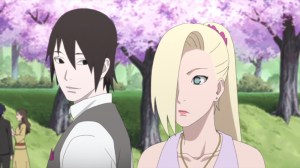
Last but not least, I have Sai. And Hinata.
Sai is point number 3, learning to understand grief and love.
(I just noticed that the problems of this show are with the overall plot and MCs, and the good parts are with side characters and their personal journeys. Make of that what you will.)
When Sai was introduced, the characters kept saying he kind of looked like Sasuke and maybe acted a bit like him…which was funny, because Sai acted totally emotionless except for a weird fake smile.
In an astounding example of the lack of self-awareness where Sasuke was concerned, Naruto and Sakura didn’t like Sai, for displaying the same freaking qualities as Sasuke-kun.
He was just so detached, and didn’t seem to care if he hurt their feelings at all, I mean who could ever like someone like that…Sakura.
Sai also asked them why they cared so much about Sasuke when he had ditched Leaf and betrayed them by going to their enemy, Orchimaru, and aiding him. Sai didn’t even say Sasuke was a dirty rat–he said he was a traitorous cockroach, which was true. But Sakura and Naruto both acted like he’s spat on Sasuke’s grave or something.
Later Sai is touched by Naruto’s loyalty, and it helps him understand something about his own past.
Sai had a friend, it turns out, who he considered to be his brother. His brother dies of a sickness before graduating the underground training. We later learn that to graduate you had to kill the person closest to you in order to complete the emotion suppression requirement that the leader imposed…you know…like you do.
Sai didn’t have to kill his brother because he died before that point, but he couldn’t understand how he was supposed to look and feel over it.
Again the show used symbolism well here, Sai carries a book of his brother and himself, and the bond they have, in the end Naruto helps him know how to finish the book.
He chooses to try to help them capture Sasuke, instead of killing him, as was his original assignment. Of course they fail.
Sai sets out on a personal quest to understand feelings. He starts reading Self-Help books about how to act around friends, and taking notes on how the people around him interact. It’s uphill work since the ninjas are very dysfunctional, and most of them are not self aware about it, but Sai beats the odds and begins to learn anyway.
He later steps in to defend Naruto when Naruto is letting a woman from Cloud village beat him up instead of Sasuke, whom she hates for harming her teacher, Lord Bee.
Reality check time: At this point Sasuke has joined the Akatsuki, a group hell bent on capturing all the people with tailed beasts, including Naruto himself, and killing them to get their power. And our lovely Sasuke is helping them do this for his own personal reasons….yeah, Naruto, you take that beating for him.
Well, Sai, who is consistently the only sane person on this show, decides to step in. Then he and Shikamaru, the other sane person when the plot demands it, decide to tell Sakura enough is enough.
Sakura listens, and tries to convince Naruto to give up on Sasuke. But the point where it would have worked is long past. (A running theme on this show was good advice too late, past when the person might have listened.)
Sai gets blown off later when he wants to stop Sakura from doing something stupid, and also wants to know what happened with Sasuke after they confronted him under the bridge.
In the war Sai does make some more friends, and start to release more of his emotions, without losing control to them. He begins to really feel that he wants to protect his friends.
At the end of the show, Sai’s arc get capped off at the same time Shikamaru’s does. I thought the show would forget about him, honestly, but instead, we got to hear how he feels insecure about his place on team 7, now that Sasuke has switched sides, sort of, they no longer need a replacement for him…not that he’s on the team, but Sai was the emotional replacement too.
Sai quite justly feels that team 7 does not care about him as much…which he’s right about. And doubts whether he has friends who truly care. Ino is able to help him by telling him that they, team 10 and Temari, who came to save him, are his friends.
Sai snaps out of the daze he was put under by the villain of the arc. It was a touching moment to see Sai get to realize he had other people who cared about him besides those idiots on team 7.
Sai is basically the person Sasuke should have been if the show was going to work. Someone who realizes they have emotional problems, don’t really understand love or how to process grief, and set out to learn to do it in the right way, after Naruto inspires them.
The lack of self awareness of Naruto and Sakura was so glaring I would have sworn it was intentional, but there never is a Euraka! moment of them waking up.
Thank goodness Sai is smarter. He’s the only one on team 7 who never blames themselves for what Sasuke does, or seems to feel any real pity for him. He only wants to help his real friends. In the end he realizes who those people are,and there are more of them then he thought.
It’s a good ending for him. And a much better message of what learning to love is, and how you can understand grief and pain better by sharing it with other people.
As for Hinata, she doesn’t have a whole lot to do with the message of the show, but she does stand as the only other girl who can recognize real value of character, and she actually can support Naruto emotionally, and back it up.
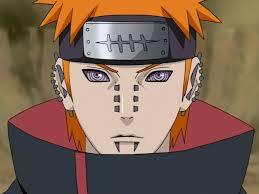
One of Hinata’s best moments is when she steps in to save Naruto from Pain. The symbolism that pain can only be defeated when we share the burden is heavy in that scene, she takes some of the weight off Naruto, and gives him love instead of blame. She does something no one else has the brain cells or courage to do, even when she was stupidly told to leave him alone to have the crap beat out of him because “he could handle it” (dang! I hate so many of the people on this show…)
But Hinata didn’t do it. Though she never gets a lot of acknowledgement form anyone that what she did was the right thing to do, Naruto later does say she saved him. The fans love her for it.
Hinata may not have the words to express it, but she does get it, more than most of the characters do. She provides the rare element of kindness, only a few characters on the show possess. She also supports everyone, not just Naruto, and tries to be kind as a principle, not just for one person, like Sakura does.
This is it folks, these are the good characters. (Who get any attention worth mentioning.)
(There is one other good arc, the Guren and Yuukimaru one, which I recommend watching, without seeing the rest of the show, because it was beautiful, just beautiful, but has no bearing on anything else in the plot, and no one learns from it. In fact it has the supreme irony of Naruto preaching a message of letting go of the wrong people that he never follows himself. But the arc itself is amazing. I can’t believe the same person wrote it.)
Thanks for reading my very long review of this show, and my fingers are tired, so I am going to end it here, until next time, stay honest–Natasha.