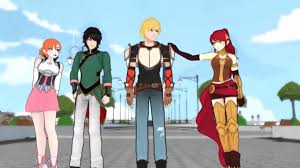
The Gauntlet.

You know, I love to draw meaning from stories, it’s one of the most fun things I know of. I hope all of you have had that experience of sitting (or standing) with someone and just analyzing a story you both like. You get such a satisfied feeling afterward.

As I mentioned, I’ve been watching RWBY, and the show is just too good not to analyze in depth. There’s a lot to choose from, but today I’m thinking of one of its more sobering themes. It’s problematic, but it plays into a common concern parents and teachers, as well as young people like myself, have with entertainment, and how we should prepare kids for the world.

RWBY has, ever since season 2, not hesitated to bring up the question of when children should be considered adults. The idea the show deals with is if it’s really correct to call kids kids after they’ve taken up the gauntlet to fight for good.

This dilemma is presented literally by Yang, a girl who actually uses “gauntlets” to fight, and makes a point on multiple occasions of saying she doesn’t consider herself a kid. Now that she (spoiler alert) has made the choice to risk her life defending the world, been on a mission armed to the teeth, and then lost her arm defending her friend, she feels pretty adult.

Yang’s perspective is understandable, but it is counted by her mentor Ozpin and also her father, Ozpin never talks to Yang about it specifically but he does wish for the youth on the show to retain some of their child-likeness as long as they can, knowing it won’t be for long. He also hopes they will  not lose their sens of humor. Yang’s father Tai tells her directly that she’s still got a lot to learn, just fighting and undergoing trauma doesn’t make her an adult.

Yang does go on to prove she is growing up by making her own difficult choices. But we are still left wondering if it had to be that way. And if it’s right for children to take on such adult roles.

It’s an old problem on shows with young characters that they tend to act more adult than the adults, but this show takes a closer look at why that is. Maybe the simple truth is that we talk down to kids, and they are capable of handling far more than we realize.

Children, as any teacher who’s had any success might tell you, are capable of grasping very deep subjects, often faster than adults do. Things like loss can be hard on kids, but sometimes they still handle it better than adults.

It depends on the person, but it’s fair to say that children surprise us with their maturity often enough to make us question if sheltering them really makes sense.

i don’t mean you shouldn’t protect kids from knowing about evil. But some people think that includes not telling them about suffering and pain, and that’s not something we really can keep from kids. There’s no sense dwelling on it, but if it comes up, should we hedge around it as we often try to do?

RWBY is honest about one thing: This is war. As a kid, that’s what I was told. We’re in a war between good and evil. That wasn’t hard to accept…it’s not really like that’s news to a child. They see the fight all around them.

But in a war there are casualties, an damages, and wounds, and losses. What do we do with those? Some say we should encourage children to think about the happier things in life as long as they can. Others that we should not shield them from harsh realities.

If I might offer some insight on what I think the real answer is…

I think that we over think it, honestly. Unfortunately, the reason we do that is because we have the luxury of it. Not so long ago, most kids would have known someone who had died, or had lost a close family member. Tragedy would not have been a strange notion to kids. They weren’t sheltered from it because there was no way for them to be. Parents couldn’t hide the truth. Cruelty and hate were things kids witnessed, not just in bullying or movies or online, but in person. Between adults.

In many countries, this is still the case. I don’t know why the West doesn’t get it, honestly, I think it’s because we spend so much time running from realities like that ourselves. For some reason, we think our happily ever after comes without a struggle.

It’s not that we should give up on happy endings, which our culture has more of than most, all over its’ fiction and sayings and ideals, and I love that about America; but we tend to pass over the part in every story where the hero or heroine had to got through nearly hell to get to the better ending.

It’s quite simple, if you want a mediocre, quiet ending, then live mediocre and run from what would make you a hero. If you want a truly happy ending, then you have to embrace the sorrow in life and let it temper you into something new.

My pastor pointed out this past Sunday that Jesus said “Blessed are those who mourn, for they will be comforted.” He said “we need to learn how to mourn.”

And that got to me, because, I don’t know how.

Golly gee whiz, I’m not the only one am I? As a freaking culture, we don’t know how to mourn. Our whole message to people is that if you get knocked down, you get right back up. You shove people’s abuse of you right back at them. You keep moving forward.

Well, yeah, you should, but first you have to mourn.

If we hold it together all the time, then our strength will be brittle and a strong enough blow will shatter us. But if we let ourselves break over and over again, we’ll heal a little faster each time.

And this applies so much to children.  I wasn’t usually told to stop crying when I was upset as a kid. Mostly, I could express my feelings. But I still bottled them up out of insecurity, a huge part of my christian journey was learning to cry over my hurt. And just let myself admit it sucked. It’s funny, when you quit trying to be strong all the time, you find things aren’t so hard to bear. Not with God’s help.

And other people’s.

And dang it, that’s what we need to tell kids. Yes, you’ll have hard times. But it’s nothing to be afraid of. It’s because we treat suffering like it’s something to fear that it’s so hard to deal with it. It can be scary, but that doesn’t mean we need to fear it coming.

And there is comfort. That’s important to remember.

–Natasha.


Thoughts on the RWBY team members.

Some of you older followers know me and how I get with show characters. I just can’t help myself, I have to delve into them. A year or two ago I did a post about characters from Ever After High and what I learned form them, I thought it might be fun to do the same thing with RWBY. Even if you don’t watch it (and I recommend it but do not read the comment section.) The show is rife with interesting life lessons.

Now, though I like most of the characters, I don’t get as much out of all of them. The thing that makes RWBY different form Ever After High (there are similar stylistic choices) is that Ever After High was very much character driven, the character’s individual perspectives were the main source of conflict. Which was great, and I have no complaints about shows like that. But RWBY is a different kind of show. It’s story-plot driven. The characters become more clear with plot development. Which means you love them more the longer you watch.

A lot of the lessons aren’t really spoken so much as implied. One would be the importance of forgiveness. Over seasons 4 and 5 especially, Yang, one of the main four, deals with bitterness toward her mom as well as her teammate Blake for abandoning her, in the end she realizes she needs to forgive Blake, and at least come to terms with how her mom is. At no point does anyone directly tell her to do this, but her sister and her friend both say different things that change her perspective, plus she learns a lot on her own.

That’s as good a theme as any to start with. The point of Yang’s arc, and Blake’s in some ways, is that forgiveness is not something people deserve, and it’s not something they can earn. Some fans have complained that Blake was forgiven way too easily, but they miss the whole point. You can never deserve forgiveness, so either it is given, or it isn’t. Yang could have waited, but it wouldn’t have changed what happened, it would have only dragged it out. I’m glad she saw that.

Blake has a hard time forgiving herself. I related to her a lot in season 4 when she talked about being tired of people getting hurt because of her. Girls especially tend to feel this way, though I’m sure boys can too, but that feeling that we bring more trouble than we’re worth. Blake’s checkered past of working with a terrorist cult (Before realizing what she was in) makes her pretty insecure about whether or not she’s really able to help people.It seems like she gets them hurt more than she saves them. There’s a very cool song “Like Morning Follows Night” that’s between her and Sun, her boy friend that illustrates what she feels and what his response is is that it hurts people more to be pushed away than it does to risk themselves for her. Blake slowly starts letting herself get helped.

Then there’s Weiss, another member of the main team. Her story is more complex than most of theirs. She is out of place in her family. As cliche as that sounds, believe me if you watch it, it’s real. I felt uncomfortable around her family as a viewer, something about them was creepy. Both Weiss and her older sister realized they needed to get away from their parents, their father especially. I normally find that story line annoying, because it’s just not justified, but in this case their dad really is evil and I can’t blame them at all. Aside from that theme, there’s an interesting side theme that children aren’t guilty for what their parents have done and shouldn’t be made to pay for it. Plus a good old crack at how the rich and indolent can live such empty lives. Which is well worn, but in this case fits.

Ruby, the team leader, was not my favorite. I liked her but she’s more young and quirky than I tend to favor. Over time I came to appreciate her though, she gives her teammates and friends some great advice. Telling Jaune, another team leader, that he’s not allowed to be a failure now that he has  a team to lead. It’s an important moment because everyone, even the fans, thinks he’s already failing and that’s kind of hard to help without him getting a serious upgrade. But Ruby turned it around to show that leadership can be entrusted to us whether we like it or not, and yet it’s still our responsibility to be the best we can.  Ruby inspires that in all the other characters.

And then there’s the other main team, JNPR (pronounced “juniper”) Aiiiy. SPOILERS!

download (3)

Seriously, I don’t know if I can bring myself to talk about it just yet. Suffice it to say they have some of the most emotionally wrecking arcs of the show.

But before and after and during that they have some of the best development.

All of them are introduced as a little quirky and unusual, and Jaune the leader, is shown to not be a very good fighter. Yet over time we see what makes them exceptional.

Jaune, though he lacks confidence, proves to be fiercely loyal to his friends and devoted to his team. Though he gets bullied and has issues with admitting he needs help, he eventually stands o]up to the bully for the sake of his team and then learns to accept help. He expresses his frustration at always feeling like the damsel in distress. Even as of season 5 he’s still the weakest fighter, but that isn’t really the point. There’s more to strength than being powerful, and there’s more to being a hero than strength. In fact what Jaune’s teammate Pyrrha shows him is that being a hero to someone is a lot more about believing in them and being there when they need help then it is about being able to kick rear. Thought that’s always fun to watch.

Ah Pyrrha, my favorite. I just love her, I can’t help it. No one can, I’ve yet to read a bad word about her.

Pyrrha was from the start easily the kindest character on the show. She and Jaune are alike in that they see someone in need and the aren’t shy about helping them. Pyrrha usually makes it look way cooler, but hey, if you can, why not?

Pyrrha’s theme ended up being about love. Something that I pinned down about her early on was that love wasn’t just something she did, it was who she was. Pyrrha is never seen doing anything mean or selfish. She inspires without trying to. Really you have to see it to understand, but you can’t watch any scene with her in it without thinking “Wow, she’s just so…nice, but like, she means it. How does she do that?”

Nora and Ren are the last two members of the team, and they’re a package deal. They balance each other out. Nora is peppy and a little crazy, but shows she is emotionally intelligent over time. Giving both Ren and Pyrrha advice that tells us she pays attention to what people are feeling. Ren is the opposite of Nora as far as personality goes and sees uncomfortable with emotions. Which is explained later, his theme ends up being getting closer and not letting anger make you do foolish and reckless things. Facing your demons and so on.

There’s even more, but this is long enough for one post. Until next time–Natasha.

The Resurrection Arc.

Hey fiction buffs! You’ve heard of character arcs before, but did you know there’s different kinds?

Yeah, probably if you read or watch any TV show that’s fictional, you knew that. I’m simply being dramatic.

You might know of arcs (and for you non-buffs, an arc is how a character or plot develops from one point, usually an immature one, to another, usually a better, wiser one. Typically the arc is what shows us the point of the whole story, but there are negative arcs that show one good guy turning bad, or a good guy slowly giving up on their cause. These are the bad example arcs that are meant to be a warning.) But have you heard of a Resurrection Arc?

Most arcs follow a pattern and this one does too. It’s actually pretty widely used, but since it is often misused, and people are now knocking it, I thought I’d write a defense of it.

All arcs are meant to change the characters and show them something they did not see before. Some arcs are a part of the plot and the characters learn by dealing with the challenges of that part. That’s what category I put a resurrection arc into.

A lot of things kick off arcs. The most famous is getting a challenge like being chosen for something, or the sadder common catalyst is a character losing someone close to them. Sometimes just witnessing a tragedy is enough to do it, other times the character has to lose their soulmate for their arc to begin.

However, there’s another really cool thing that kicks of some arcs. And it’s a resurrection. A resurrection can happen one of two ways. Either it’s a character literally coming back from the dead, or from being almost dead, or they just thought they were and it turns out they weren’t; or something else can be restored to a character that they felt they lost. In fiction especially this can mean a gift or power, or it can mean a belief in something they had lost faith in. It’s popular now for a memory to also be something that helps a character in this way.

In older stories resurrection is often just straight up someone’s coming back to life. This theme appears in fairy tales way more that we realize. Often it’s intertwined with redemption. Many of Anderson’s lesser known stories involve resurrection, and even his most famous ones that have had those elements removed in the retelling.

In modern fiction Death has an oddly compelling presence. Take “The Fault in Our Stars,” or almost any dystopia fiction now. Death is everywhere, often very young people are obsessed with it. (Funny that it’s often older people writing this stuff.) I always loved life, I was happy when nobody died. I considered “The Lion King” a sad movie, (and that part still is.) But of course, Mufasa isn’t really gone, and that can be part of a resurrection arc. Realizing that death isn’t so powerful. It’s why you won’t see this arc in the death-shadowed stories I just mentioned, unless it’s in some twisted, unholy way. Frankenstein’s monster is no example of resurrection, just to be clear.

Life wins out in the end, and love. That’s the message of resurrection arcs in a nutshell. But the complaint, which I’m sick of hearing, is that they don’t create lasting stakes.

Since the Avengers franchise took off, fans have been growing dissatisfied with happy, everyone’s alive, stories (like they don’t all hate it when their friendly neighborhood Spiderman gets knocked off, please.) While I find the constant whining about it to be stupid, I do note that there’s something to be said for making things a bit more realistic.

It’s not that no one dies that really bugs me, it’s that no one gets hurt for very long, no one loses anything in their lives, and no one seems to be affected for longer than two films by any traumatic experience. Also I fail to see character growth even when they are.

In truth, whether characters live or die has nothing to do with depth. Action flicks that kill off henchmen by the dozens aren’t known for being deep. And Chick flicks that don’t kill anyone, or else do it in a more drawn out, romantic way, aren’t necessarily shallow. The Notebook is dumb for most of the movie, but the ending always gets to me because it is saying something profound about love.

That said, I think people who knock resurrection arcs are missing their potential. It’s not always a cheap cop-out to have a character not stay dead. In fact, often it’s a very good catalyst for growth in both them, and everyone else.

When a characters is resurrected, everyone has to reconsider what life and death means to them. They have to ask themselves what they are willing to sacrifice, and what they aren’t. But most of all, it changes the dynamics of how they see the antagonists. Maybe there are things more powerful than whatever the evil stands for.

As for the character who comes back themselves, they get a chance to change things about their lives that maybe only losing them gave them the clarity to do. Or they impart some wisdom on the other characters that they couldn’t before. Resurrection means restoration.

If we no longer like that, it is because we have grown more hopeless. It’s more cool now to just accept the crap in you life and deal with it, then it is to hope for a change. People encourage you to give up on hoping for others to change, for things to turn around. Be the force, they say. Well, that’s fine in its place. But what about when your force isn’t enough?

What about when all the kick-rear skills in the world won’t save you? What about when you’re losing heart and nothing else will help? What about when someone simply can’t save themselves?

Resurrection is what solves this, and nothing else can. It’s a restoring of life and hope and faith to someone who had lost heart. It’s the only thing that makes redemption fully possible. Because though a death may redeem someone, it only sticks if life comes out of it.

Resurrection, in the end, is what breeds humility. What engraves the inevitability of our own need for someone to intervene on our behalf into our souls. By overcoming mortality, it reminds us of it.

It’s not cheap. It’s often the hardest thing to do well.

I for one will never get tired of this arc, until next time–Natasha.

Character Grief.

That moment where you’re innocently watching your favorite show or reading your favorite book series and then it happens. you stare at the page/screen in abject horror. You slam the book shut, you shut your laptop. You yell “How could this happen!” You scream.

Because what just happened was they did something you never saw coming and you felt in your bones was a bad idea even if you did.

Now you’re left with that strange phenomenon known as Character Grief.

Actually I just made up that term just now, but it’s a thing.

It’s not a fun condition, but not everyone suffers from it. Here’s a way to rate yourself.

1-5: If you are mildly annoyed, and tell your friends or family it was stupid, but other than that you don’t do much.

5-10: You cry and can’t bear to continue, or you cry and then re-watch or reread said materiel over and over again because it’s cathartic, and tell your friends because misery loves company.

10-15: You give up the material in favor of less infuriating entertainment and proceed to tell everyone else it’s no longer worth their time.

15-20: You get so upset that you figure out ways to solve what happened and fan fic your way to mental peace. Extra points if you convince your family or friends to join you.

And extra points if you do every single one of these things. Like I do. Except cry, I rarely do that.

Character grief is different form plot frustration. It’s more personal. It sticks you in your craw and wounds you to your whimsical/imaginative core.

I think Character Grief happens in one of three ways.

  1. The least painful, most annoying way is when your favorite character simply is left out or disappears from the story. This can happen with books made into movies, like how Tom Bombadil got left out of Lord of The Rings. And all my favorite characters got left out of the second Anne of Green Gables movie.
  2.  The most painful, actual death. I mean unforeseen, or totally unwanted character death. It feels unnecessary and it leaves you sad for days. Probably you can’t even go back to the story without crying or reliving those emotions.
  3.  The last way is the most poisonous, but that does make it easier to be mad about and less sad. It’s when a character is radically changed for the worst. They could turn evil (like Ever After High), or they could lose their most lovable personality traits. This happens a lot with the books to movies thing , but it also happens when new writers or producers take over, or the creators stop caring for whatever reason. Like Shrek: the Final Chapter. The change is usually brought on by the character doing something they would never actually do if you went by previous traits they exemplified. The action violates their moral code, and they haven’t been brainwashed or anything that would make it seem reasonable.

The last two bother me way more than the first one. And I take it hard. I can’t just quit the thing like some folks who don’t get involved.

So I though I’d write this post to speculate about why Character Grief happens. There’s probably research on it out there, but it’s tricky to explain because every person is different.

The first thing that shocks you about character grief is that it feels like real grief. Though a part of you remains separate from it because you know they cough* aren’t cough* real. (Angry gasps form people who’ve felt this before.) yet you still feel sad, mad, and in denial just like when real grief strikes.

Actually, with real grief I tend to go numb. A part of me just can’t believe it really happened. Even when I accept it, I don’t feel strong, out of control emotions. I don’t sink into depression. somehow I distance myself form loss. I don’t know if that’s a good thing. I’m learning to explore those emotions more.

But character grief has a way of cutting through my defenses. Much the way spiritual things do. It’s almost like when I can see and hear the loss, and it affects my physical world, I handle it. But when I can’t, and it doesn’t seem to, then I get cut to the quick.

With real loss, I feel the unfairness and helplessness people talk about.

With loss in imaginary things, I feel like my heart got ripped out.

I think partly because in fiction, you see people more clearly than in real life. There’s less sin and misunderstanding to cloud your vision. You just see them s people.

Maybe if in real life we could be that honest with each other, caring would be easier.

because to be honest, we make it hard for people to love us, don’t we?

I know I can be difficult. The people who love me most are the ones I can’t hide from as well.

With strangers we are on our best behavior, but do we really connect with people until we know they’re flawed and we accept them anyway?

I love characters who are better than me because I can see them just as people, I don’t have to worry about them doing wrong that I’ll have to fight against. IF they do slip up, I know they’ll recover.

The people in my life who I know will pick themselves up after they fall are the ones I trust the most.

In fiction, losing that person, whether to bad writing, or to a tragic end even if it is well written, can feel like losing a friend.

People have always thought those who have imaginary characters as friends were kind of odd. But I think we have them because they have more of the author’s soul than we might see if we just met the person. When we can get our cumbersome flaws and failings out of the way through our creativity, we see each other better.

Not that it always goes well, but fiction fans live off the times that it does.

Some other time I’ll talk about how character grief can also teach us about hope, but I’m out of time for now, until next post–Natasha.

Pure Love and the human condition.

Hi, sorry I’ve neglected you guys. I was not feeling good this week and I had a lot of homework to catch up on. Thankfully my books arrived!

I’ve had the time, however, to get hooked on a new show, it’s called RWBY. I don’t often say this about anime anything, but I recommend it a lot, though it is not finished yet, and if you watch, be prepared to wait a few years for the conclusion because each season takes about a year to come out.

But two seasons was enough to sell me on it, season 3 ripped my heart out, and seasons 4 and 5 continued to blow my mind. Season 6 comes out next month.

A little summary before I get to my real point: RWBY is basically a superhero team set in a fantasy world with heavy spiritual undertones. Or even overtones sometimes. It features a host of likable, deep, smart, and none cliche heroes who you actually want to imitate though you wouldn’t want to be them per sec because they have problems. Not petty issues, but actual life challenges. I’m pretty sure this show is aimed at older teens. The show features villains who you will utterly despise even though their motivations are explained to you, which is a plus in my book since I never liked sympathizing with evil characters. They are not two dimensional, but the show makes it very clear they are evil and you do not want to be like them.

But that’s enough about the show. What I really want to talk about is the contrast between the show’s view of human nature, and the one I’m getting in my Critical Thinking Class. I don’t know who picked my curriculum, but it’s been the most depressing stuff I’ve read in a long time. and I just read Fahrenheit 451. Each short story or novella has featured the theme of human nature, I guess it’s the point we’re focusing on for these weeks.

According to these authors, human beings are cruel, unfeeling, ungrateful, willing to abandon loved ones as soon as they become an inconvenience, and on the brink of insanity constantly.

I know some cynical person might look at that list and say “That sounds about right.” Yeah, that person might not like what I’m going to say.

THIS IS WRONG! WRONG. WRONG. WRONG.

I won’t name all my sources here because I think you’re better off not reading them, but the highlights are a story about a man turning into a cockroach and becoming a monster to his family; a woman killing her boyfriend and committing necrophilia; a man with a mentally disturbed employee who starves himself to death after becoming a nuisance to everyone around him; and a man who removes his wife’s one blemish because he can’t bear imperfection and kills her by doing so.

Now if all those sound like something you’d never want to read, be glad you aren’t required to for the course. I actually enjoyed a chapter about straight logic more than I enjoyed any of those.

I do come up with dramatic things when I write my fiction, but I stick mainly to what I’ve seen on TV, or what I observes in the spiritual way of things. You could argue the case for all the above stories having spiritual connotations, but they aren’t ones worth being talked about.

The Bible says of the corrupt that it is shameful to even speak of the things which they do in secret. I don’t think it means that you never expose wickedness. But you should be really careful what you talk about just for the sake of conversation or discussion. No one should bring up the darkest parts of humanity for table talk.

By contrast, RWBY, unlike all the stories I read, has the bad and good sides of people both. It’s most notable example is Pyrrha Nikos, who is hands down one of the best characters I ever saw on a show. Pyrrha demonstrates something that I have seen in stories I’ve read by C. S. Lewis, Louisa May Alcott, and Francis Burnette (A little Princess and The Secret Garden.) Stories like Heidi, The Enchanted April, The Bronze Bow, Anne of Green Gables, or even comics like Mr. Miracle and Spiderman, all contain exceptional people. People who, as George MacDonald would say, demonstrate “the common good uncommonly developed.” It’s my rule of thumb that if you find no true love in a story, then you find no truth. You’ll never separate those two things with any degree of honesty. You have to search for that one character or theme that demonstrates love, pure love.

Pure Love is an ideal for human beings. While it is possible for us to have it, it takes much growth and much sacrifice on our part. It is true that few of us are willing to undergo that kind of suffering. I could describe Pure Love as a concept, but I prefer using characters. Characters work better than real people in this case because unless you’re fortunate enough to know someone like them, most of us haven’t met anyone who exudes that kind of love all the time. A character is someone all of us could potentially see and hopefully understand.

Pyrrha Nikos struck me because I could never catch her doing anything selfish, no matter what scene she was in. All she ever seems to want is to connect with people and help them. I have seen a few characters like that, but they got ruined in the end by irresponsible writing. Surely I am not the only one tired of show writers growing cynical about their own characters and dooming them by violating the characters own convictions for the sake of the plot…ick.

The point is Pyrrha and the others stand up for what is right and don’t want to just stand by and let bad things happen. And I believe there are people like that in the world.

You probably won’t find them on TV all that much because unfortunately, the reason these stories are on my curriculum is because as a culture we have turned to the dark and the depressing, the antihero and the straight up bad guy. Our world is sick. But, that does not mean we do not have the healers in it. I don’t know anyone who always radiates love except Jesus, but I do know I want to be that person. I have a long way to go. But because I believe God transforms us, I believe I can get there.

The short stories made me feel like garbage, selfish scum of the earth, and that was not based in any reality or likelihood that I would do what the people in the stories did. I can honestly say I wouldn’t. But these stories don’t make me sit back and ponder my life choices as much as they make me think “people suck, at least the ones who wrote this trash did.”

RWBY shocked me with it’s real look at what it’s like to be in a war against evil, but that shock made me remember values I’ve been forgetting for some time now. And it made me want to live up to them again. A part of me was beginning to think having pure love was impossible, but I was reminded that I sure as heck should keep trying anyway.

It’s a pretty pass when an internet show has a better grasp of reality than literature in a Critical Thinking Class, but one cannot disregard humble messengers. Oddly enough, people who expect to be taken seriously the least can often put out the most worthwhile material, because who do they have to impress?

I guess my closing thought is, surround yourself not with what seems the most hard look at life, but with the one that strengthens your values and makes you want to be a better person. That’s the stuff worth engaging in.

Until next time–Natasha.

The Incredibles 2

Whew! I’m sorry I haven’t posted, I’ve been working on a different project and there’s only so much screen time my eyes can take per day.

But I had to get this out, late as it is, but I have finally gotten to see The Incredibles 2!

I know I’m tardy, but hey, I can’t afford movie tickets, my dad took us. I know that some people may still have not seen it, so I’ll warn you there will be spoilers in this review.

But my overall impression was that the movie surprised me. Given the kind of sub-par Disney and Dreamworks sequels we’ve gotten over the past five years or so, (with how to Train your Dragon being an exception) and the reboots of old Disney Classics that did not go over well, it would have been hard not to be skeptical, add that to the fact that The Incredibles is one of the most brilliant superhero movies or kids movies ever made, and who was not cynical about it’s prospects. Everyone I heard was.

And we were partly right, the movie is not as good as the original, but strangely enough, it’s not a bad movie either. It’s actually above what’s come to be average.

What did I not like?

There’s plenty to not like in the film, mostly int he first 40 minutes or so. The movie had a bad case of the 15 year later addition loss of personality syndrome. Even Toy Story 3 lost a little, though I still think that movie is freaking amazing and it makes me cry, and the characters didn’t change much in it. But you can’t say that in this case, Mr. Incredible,or Bob, is the most notable example. On the surface he has the same issues of wanting to be superhero as he did before, but they really ignored all his vies on mediocrity and his concern about helping people. The mediocrity stint comes in a little bit but the focus was more on how unfair the law was. More on that later.

Dash also got hit hard, it wasn’t so much that he lost his personality as that he was barely in the movie at all except as a background character. Somehow the first one managed to give even the characters with no lines, like Jack-Jack, or minimal lines, like Violet, a lot of personality. And Dash just seems…out of it. He was still fun for what he did do, but I miss the kid who just loved using his powers.

The biggest thing not to like however was how they dumped on poor Tony Ryanger. What happened to him was completely unnecessary. The movie opens up with his perspective, which is an interesting idea that I would normally like. What does it look like to a normal kid to see a super villain shoot up out of the ground near his school? Him seeing Violet without her mask might have been interesting too. But then he gets his memory of her erased…and never gets it back. If you knew me and how many times I’ve ranted about this very thing in shows, and I watch so much super-related stuff that you can guess I’ve seen it quite a few times. It’s a common action theme also. Suffice to say, I didn’t like it in X-Men first class, I didn’t like it in Phineas and Ferb: Across the Second Dimension, I don’t like it any other time it pops up. Even Barbie has done it. My reasons are: First of all, memory erasing is unethical, and it’s always good guys who are doing it, usually the government. Which is disturbing on so may levels. Second of all: It’s unfair. Often the character never even gets a chance to be found trustworthy or mature, which happened in this case, they get their free will removed by the event. Third: This is the least wrong thing, but it is just lazy writing. You get someone to forget and you don’t have to deal with the far reaching effects of the dumb idea. Like, it was dumb to do it in the first place if it couldn’t be resolved any other way…which it could have!

I really was almost ready to cry for poor Violet, she’s always been my favorite character and I completely felt her pain. What teenager doesn’t know the frustration of your crush not even knowing you exist!…this time literally.

And Tony, who I also liked as much as he was in it, never gets his memory back, which seems just too unfair. Why should someone’s mind be able to be messed with that much?

Anyway, that was the bad, and it did leave a sour taste in my mouth even at the end of the movie, so that’s a big problem. But now for the not bad.

Though this will depend on your point of view, because the villain in this movie was full on Scary. And I mean that I started getting a Matrix/horror film vibes during one part. It was like a much more mature movie. Now I know a lot of my shortsighted peers are gong to think that’s a good thing, but as someone who works with kids and still remembers what it was like a thing movies like that when I was younger, I cans ya I’m not sure I would show this to my seven year old. Maybe it would go over their heads, but it’s pretty interest. The hypnotism, seeing the heroes you loved being mind controlled into doing evil, and it was scary. They were more terrifying then Baymax going all hulk like for a few seconds in Big Hero 6. No one would have a hard time empathizing with Violet and Dash when first their parents and then their Uncle Lucius end up controlled by the Screen Slaver.

However, because the movie does turn serious rather suddenly, it did have a compelling message. Unfortunately, the compelling one was the villain’s. The Screenslaver calls out our society for being very much like the one in Farenheit 451 (which I just recently read) how we like everything packaged to us, deliver to us in a safe format that we can process. Our danger come s via screens, our talks shows substitute for talking to each other, and we prefer to let superhero take care of a our problem while we watch form a distance, safe. Which is exactly what happens in Farenheit 451, only the problem the police are taking care of is actually the worlds’ salvation. It would be easy enough to see how the Screenslaver would put themself in that position Especially since that protagonist murdered and framed people also to ensure his escape. It’s not the happiest book.

The things is, as the villain points out at the end of the movie to Mrs Incredible. “Just because you saved me doesn’t mean I’m wrong.” And it doesn’t. However well-intentioned Mrs. Incredible might be, she cannot really disprove the villain’s points because by nature she is outside regular society. She has to be. Supers can’t afford to be lazy and indolent.

I love good characters, and I hate it when people say the villain was them more interesting one. And I won’t say she was more interesting, but in a very Marvel like fashion, this movie makes the villain’s case and fails to make the heroes.

My family and I discussed how in real life when disaster strikes, you do see ordinary people coming to the rescue. My dad pointed out that it happen during 911 on the planes, where passengers stopped the terrorist. It happened at the shooting at Columbine high school. It’s happened recently. In fact disaster brings out the best and worst in people. Humans who have some mettle in them rise to the occasion. It is because we have such boring lives that most of us are neither bad nor good. And it is also why Moral Relativism can be so popular. Frankly, only a bored and lazy society could even buy into it. Disaster forces you to pick a right or wrong, you have no choice.

That said, the villain’s professed intent is to scare people into waking up to how fake their society is by using that against them. However the movie show no ordinary people coming to help the Incredibles. In fact the ordinary people are either fired, taken out, or have their freaking memory erased. Anyone who might’ve disproved her point is removed from the equation and no one else is provided. Unlike in Spiderman where the New Yorkers were inspired by his heroism to stand up to the Goblin and Doctor Octopus.

It may be true that many of us here in the real world prefer to watch superhero movies because of escapism. But some of us, like me, are looking for inspiration. Looking for an example to be held up somewhere for us to follow. Oddly enough, in the first movie, Buddy gets this. Though he gets it in an obsessive way.

I call it Marvel Syndrome, the disappointing fact that a movie can explain the villains perspective and even back it up with its own fictitious events, but not do the same for the hero. And that’ a problem. because words have power, and people will remember them. I see the disrespect for human beings spreading in these movies. And though we give lip service to the heroes, we are are sympathizing a lot more with the villains because it seems like they are right. I have endless examples of this just form Marvel. Thankfully at leas Wonder Woman did not fall into this trap. She rocks.

Anyway, despite all the time I jsut spent on what eas wiehter bad or problematice, there is a lot of good in this movie.

I loved having Violet being the smart, take charge character that she became in the fist movie. She didn’t lose that, and that was huge since a lot of the other characters suffered set backs in their personalities. Even though Violet gets burned by being different more than anyone except her dad, she was still willing to don her suit and jump in as soon as she realized what was going on. and she’s definitely the one who can think, she figured out the villain’s plan, how to save the ship, and creative ways to fight the bad guys. She and Dash still have their funny brother-sister exchange.

Dash’es one real charcter moment was usning the incrdibile. Taht was funny. And a good chekovs’s ugn pay off.

And I’ll give Helen this much, she does get fleshed out more. We come to see why she loved being a super hero. And we know she gave that up more willingly then Bob, but she gets to rediscover why she was all “Hey, we’re not letting the men do all the saving. I’m at the top of my game!” And though Bob of course originally was the one who wanted to settle down she was the one who made it work, and she still keeps her family at the top of her priority list even in the midst of chasing down a train. It was great to Helen have her time to shine, yet to be honest, I came to the movie for the family. And we do get it for the last 20 minutes, similarly to the first one.

Now the final battle was not quite as climatic. A ship crashing into a city jsut doens’ thave the smae irng to it as a giant Robot wrecking havoc. But it was dramitc enough to give everyoen time to shine. wE get to see FRozone do a lto more and be a lot mro powerful, which was cool. No pun intended. Mrs. Incrdibles’ fake out to get eh villains’ guard down was clever, had me going almost. I kind of missed Bob having a more cirtical role, but fair enough, he got the winning shot int he last movie. It’s not all about him.

Now to talk about the other message of this movie. There’s a few different one.s One is that people who are true heroes will rise both the family and to hero work equally. Both Bob and Helen have to do this. And so do Vi and Dash, by keeping an eye on Jack-Jack even while rescuing their parents.

But I think there’s a more interesting message. No counter point is ever made to the villain, except just once, when Helen points out that she at least has core values, even if the villain thinks they are stupid.

And that is the hypocrisy of the villain’s plan, claiming you are trying to help, but being wiling to sacrifice other people to get your way and ave your own skin. That’s not heroism.

But even more than that the overall attitude that the law has in this movie, that supers are too dangerous to have around. And yeah, that’ about as original as capes and cowls by now, but the movie approaches it a little differently. The idea being that people are afraid of people who are special. That’s in the fist movie more, but if you take that foundation, then this movie makes more sense. It’s kind of like the whole anti-gun movement. Something is powerful, it’s dangerous, so that automatically makes it bad unless the government controls it. (Ri-ight.)

It’s too risky. But the movie shows that when we remove something good just because it has dangerous potential, we shoot ourselves in the foot. Because danger is what protects us as well as threatens us. Just like we need germs to have a strong immune system, we need danger in order to not be taken out by it.

Superheroes are like that. It’s not only unfair to outlaw them, but it is  unwise. Threats arise, and accidents happen because of them. But how much more could and would happen if they weren’t there? The villain could have hated people just as much without the added motivation of hating supers. And then who would have stopped her?

Eden if supers are not strictly necessary, they have gifts and they should use them for good. It goes back to being special. The question might be do we need exceptional people to keep moving us froward in order to survive? Maybe not, but we need them for other reasons. We have to have leaders, we have to have heroes. They remind us to not just subsist, but to do good.

And that’s what I’m leaving you with. Until next time–Natasha.