Friends or Family?

Well my family has left for vacation, and I am staying at home.

I’m not completely alone, my grandma is still here.

This is going to be the longest I’ve gone without seeing my family. Three weeks. It will be hard, my siblings and I are each others’ closest friends.

We spent our last full day together with another friend, and then watching our favorite anime together, (it’s My Hero Academia if you’re wondering.)

One thing we talked about in passing was how we’ve had difficulty befriending someone we know, and it seems like they don’t really want us to.

I pointed out that church (where all but one or two of my friends are) is supposed to be family, as the bible says, but if you look at how we’re instructed to behave to each other, it sounds more like friendship.

Proverbs even says better is a friend close then a brother far away, and there is a friend who sticks closer than a brother.

Then I pointed out that we three have always been family, and we have always related to each other as sisters, but that it was only the past 5 years or so that we chose to also become friends.

Up until 13-14 I’d say, I treated my sisters like sisters. People who annoyed me, and who I could annoy, with no fear that it would end our relationship. There is a security in a healthy family, room to grow up and develop, while making plenty of mistakes along the way that family blows off, while it would end most friendships.

Of course, the biblical way to treat siblings is nothing like that, but as most adolescents, I didn’t care.

But after returning to Christ, I began rethinking how I acted. It didn’t change a whole lot until my sisters did the same thing, but overtime we began to build our relationship into something very strong. We enjoy it now. We enjoy each other’s personalities, and we are our closest confidantes. We have the kind of sibling-hood you read about.

And sometimes that amazes me, because I know it didn’t have to be that way. I’m so glad we all chose to become friends. (There’s actually a show on Disney Channel that addressed this idea, Liv and Maddie, “Sisters by birth, friends by choice.”)

I was comparing it to the Church family. Once you become a christian (as our doctrine goes) you are part of the family. And the basic instructions off the bat are that we accept you as such. overlook you faults the way a family would, and be your support. If we fight, we also forgive quickly.

That’s a family dynamic, a baby Christian needs that because they will get a lot wrong in the first year or so. That’s okay. I did too. And I was raised in Church. You cannot teach spiritual maturity, only exhibit it and hope it will benefit other people. I had my  mom as an example of it for years before I learned to emulate any of it.

A new Christian is only beginning to be a new person. And that makes them immature. We are meant to show grace.

The sad thing, a lot of churches do not even reach the family dynamic. They don’t accept people, they don’t forgive, they don’t support.

This does not mean that it doesn’t work however. The problem with corporate church is that the same flaws tend to creep in as with businesses and charities, many just don’t do what they should because management skills are not adequate.

Which is why I think the church was never meant to be a corporate experience, but there are people who find a way to work the system.

Many churches do find the family dynamic. But what the New Testament instructs us in is far closer to friendship in many ways.

We are not just to support each other, but to find each others strengths and talents, and develop them. We no longer just accept, we are also to correct, to sharpen each other. To hold each other accountable.

Family can do this, but it is something that comes more naturally into a really good friendship. Family can be too close to see the problem. Friends build distance on purpose by having diverse interests, getting space from each other, and so they learn more about the other person because they see them from more angles than if they lived with them constantly.

The church is designed to meld these two dynamics into a hybrid I think only is possible in spiritual ways. It is really difficult to explain until you experience it. My family became my friends. I hope someday to have friends who will be family.

The trouble is, churches can not really support friendship. I have a church that supports family a lot. Better than most places do. But it is still trying to figure out friendship.

A lot of discipleship we do is focused on family, one girl who’d been through their school of ministry even admitted to this. Not a lot of it is focused on friendship.

Yet, I think a lot of what the epistles show us is how to be a friend as well as a brother or sister.

I think in Acts, the apostles already had a family dynamic, but after they started to travel and organised, they had to have friends.

My dad has learned the hard way that family can be heard to organize to do anything if everyone acts as and individual. It takes the build up of friendship, the learning to work with a very different person, to speak their language, that allows for teamwork.

Some families achieve this with seeming ease. My family never had been particularly good at this except in crisis situations. I think it depends on how well the family knows itself.

A lot of friends now are not on this level, thanks to the lack of interaction we have except through technology, but you’ve probably met or known people who still have this teamwork ability. Hopefully you are one of them.

And my whole point to my sisters was that this ability is a choice to develop. That is what makes it different.

We have no choice about our family. We need to accept hem no matter what.

But within the family we tend to have friends. It won’t be every remember, an not the same for every member you do have it with, but there will be the odd person here and there.

I have a bond with family I only see once or twice a year because we are family, but I have a different bond with people I choose to be around and are not related to me except by faith or being in the human race.

I realize a lot of this post may only be interesting if you are a christian, but it was something I had not realized before, and I’ve been in church my hole life. Plus, it’s always interesting to think about social circles like this and how they work.

Plus my real point that friendship is choice, it doesn’t just happen, is one I think many of us need to understand. Myself included. Movies show friendship as something that can happen in an instant…sometimes it can, but I have never found those friends to be the ones I am likely to see the most often or talk to the most… Maybe God in his wisdom reserves the instant friendship bond for a more eternal significance. The people you surround yourself with are going to round our your rough edges, and that’s better for you.

Until next time–Natasha

Speaking of friendship, it is a factor in the book series I am publishing on Kindle, here’s a link if you want to check out the first two installments, more coming once I replace my laptop-

You can also visit my author page and ask me questions about the series if you’re curious about how me and my coauthor came up with the idea.

Thanks for your support!
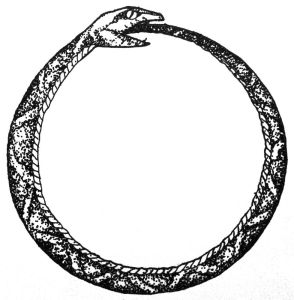
The Snake Cycle.

Okay, Thomas Sanders, I admit it, you are a freaking genius.

You may not know it, but it’s buried in there.

I was reading  a book by G. K. Chesterton and I came cross an analogy for eastern philosophy’s view of eternity that arrested my attention, because I hear it used elsewhere.

Ironically, I do not think Thomas Sanders, winner of best YouTube Comedian Shorty award (hope I spelled that right), knew exactly what he stumbled on…or Joan, his friend who helps research and write this stuff.

It’s the snake devouring its own tail picture. I did not know it was a real symbol, but apparently it is. (In occult stuff, as well as Viking culture. Weird.)

9eff4aa32768e751963a2221e13b98b0

I believe, given what I know of odd eastern mysticism, it would mean in that context that eternity flows in and out of itself, it feeds into itself, starting over and over again, regenerating, reincarnating.

Some cultures view time as cyclical, or traveling in a circle, which is why we have repeating patterns.

The biblical view of time is better represented by a wheel that rolls on a line, like the seraphs from Ezekiel’s vision, cycles repeat, but changes and alternations and progress still happen. Time is a vehicle getting us from one place to another. The only way a mortal being could travel without being burned up.

You’ll find the idea in “A Wrinkle in Time,” the 4th dimension is time, which is another way of saying the 3rd dimension is solid objects and the 4th is them moving. The 5th dimension is moving through time, or more accurately, moving time itself. Bending it.

That’s not really relevant to this, except as a concept slightly different from the repetition of the eastern view.  Even they think you reincarnate into better or worse states, as I said in my last post, all religion seems to share the idea of a better or worse end after death. In this case Karma is what decides that.

To be fair, I’m sure there’s nuance depending on whether you’re Hindu, Buddhist, or some other variation of a reincarnation-believing religion that I don’t know about because I live in the West. (Hey, it’s hard to keep track when you don’t live in it.)

But the point is, Thomas Sanders links this odd idea to the idea of losing motivation. He only applies it to creating his videos, but it easily applies to more than that. He actually sort of acknowledges this in other videos about “Why do we get up in the morning?” and “Learning New Things about Ourselves.” Even coming into the more lighthearted “Becoming a Cartoon.” He has a habit of getting existential.

Being the unashamed nerd that I am, I find his philosophy to be the most interesting part of his videos.

If you want to see for yourself, 6:00 minutes in is where the part that really interests me happens. I want to give credit where it’s due.


Patton (Morality) describes the creative process as a whole, mushy vision, and the solution to this is Logic. Yet Chesterton points out that a purely logical way of viewing things only narrows your perspective. The creative process may be unclear, but that mirrors how we see life, not always clear on what is happening, but able to see more because we cannot see all, than by trying to fit all into our logical minds.

That leads to a very dark, bleak, panic as Logic in this video discovers, being the solution to a problem he has caused. And those who try to see the world with reason alone find themselves in that  position, as Chesterton elaborates:

“Their position is quite reasonable; nay, in a sense it is infinitely reasonable, just as a threepenny bit is infinitely circular. But there is such a thing a mean infinity, a base and slavish eternity. It is amusing to notice that many of the moderns, whether skeptics or mystics, have taken as their sign a certain eastern symbol, which is the very symbol of this ultimate nullity. When they wish to represent eternity, they represent it by a serpent with his tail in his mouth. There is a startling sarcasm in the image of that very unsatisfactory meal. The eternity of the material fatalists, the eternity of the eastern pessimists, the eternity of the supercilious theosophists and higher scientists of to-day is, indeed, very well presented by a serpent eating his tail, a degraded animal who destroys himself.” (Orthodoxy, G. K. Chesterton. Pg 47.)

This got me to thinking about the anime I watch. I’ve noted this particular philosophy to be present in it. It’s a common one in anime, and other eastern influenced stuff, it’s also frequently found in the Church. It’s a common idea to men.

That you can, like with a piece of wood, whittle your character down into something beautiful and smooth.

katsuki-bakugou-my-hero-academic-4k-3o

My Hero Academia‘s eastern philosophy of lopping off all the bad habits and tenancies and honing your skills down to the basics. That you have a basically good nature, with potential, but you need to be trimmed, (it is literally expressed almost that exact way in Best Jeanist’s words to Katsuki Bakugo in Season 2.) It’s basically the same thing. And the same as the materialism which Chesterton is referring to, which by the way, he compares to madness.

The idea that materialism shuts out everything but just the material. It’s literally the definition, but the definition is awful, he thinks, because it is so narrow.

It may encompass the whole world in that it is a world view, but it also shuts out much of the world, anything that can’t be measured by matter. Including our emotions.

My Hero Academia is not that extreme. It certainly has a better worldview than materialism. It’s not completely wrong to think we should cut out the bad things of our lives.

The bible teaches that.

But here’s where it deviates, and I may add, where Thomas’s Logic has to cooperate with his Morality, since he is smart enough to know nullity is not the way:

The Bible says not just to remove evil, but to replace it with good. The idea is not to be some enlightened martial arts master, cut off from all negative emotions, inner peace is not the annihilation of troubling feelings, but the overcoming of them with better ones.

Few people can succeed at shutting off their feelings completely, even depression is a feeling, and those who can are only less able to understand them. But it’s far most possible to overcome our emotions by focusing on better things. OF course, we still deal with the bad stuff, but we do not dwell on it.

I could go for a long time about all the fictional examples of this, and even real life ones, but I think I can leave it here.

Good for you Sanders.

And Chesterton is a genius also.

Until Next Time–Natasha.


What’s Your Name?

“Who can give a man this, his own name?” –George MacDonald. (Unspoken Sermons.)

Hi, I’m back today with a much more mystical subject than I’ve been covering, (and by the way, mystical is not the same as mythical, mystical can be real, but very hard to understand unless you are a Mystic.)

What brought this on was recently watching the Anime Best Picture winner “Your Name.” I was both skeptical and hopeful when I heard about it, and so my siblings and I decided to try it out. We’ve only discovered we like anime over the last year or so, and we’ve been slowly trying different kinds. (I seem to like Slice of Life best aside from the shows I’ve gotten into.) I loved Koe no Katachi, a different anime movie, so I thought, what the heck?

And I thought Your Name was one of the most beautiful movies I’ve ever seen, from a visual and story perspective, though not without its flaws.

However this is not a movie review, watch it if you’re into that sort of thing, otherwise don’t bother, if anime turns you off. But the concept of the movie was something I did want to talk about, because part of what  I liked about it was how similar it was to other things I’ve read, and it’s mostly read, since I’ve seen few movies tackle the subject.

The movie centers around a couple different ideas which I’ll list here for clarity before breaking them down.

  1. The idea that Love transcends Time and Space
  2. The idea that there’s power in knowing someone’s Name.
  3. The idea that people are destined to meet, despite whatever impossible obstacles seem to stand in their way.
  4. The idea that time is interwoven, not just a long line of events.

The first two are the most important, and the ones I feel the most informed of, if you could call it that.

I happen to be a fan of Madeleine L’Engle’s first three books in the Wrinkle in Time series, my favorite out of the three is “A swiftly Tilting Planet,” it’s amazingly complex for such a short book, and it focuses on Joy, and Love, like all three of the books do, as well as Time Travel.

What’s interesting about it is that just like in “Your Name” the boy in this book time travels by going within someone else. Only it is several different people and all male. Also he other person’s conscious remains. he just blends into it, giving them help when he can but only subtly. they can’t know it’s him or it would scare them too badly. It is not possessive, but sharing, like a passing traveler.

The boy, Charles Wallace, goes within for the same reason Taki in the movie does, it is to redeem people and save others. There is a disaster int he book that is going to wipe out the world because of an evil man, and he has to redeem the parents of this man and save some of them also. Taki has only to save an entire town, but it proves just as difficult.

Interestingly, both stories share the theme of someone forgetting quickly as soon as they come out of it, what happened. Only, instead of Charles Wallace forgetting, it’s Meg who is only helping him by a sort of telepathic connection they have (more spiritual than mental) and because she is not there, it fades from her mind. Like a dream. Other characters in the book have dreams that are actually from Charles Wallace’s life, while he is within them.

I find the similarities astounding.

Here we have the idea that lives can be shared across time and space, and it is because of love, joy, and the need for salvation (in every sense of the word) that it happens. We have the idea that our spirits are not bound by time, space, or our minds. Because Meg’s mind may not be able to retain it (her brother has a rare mind that is able to, not many people do) but her heart and spirit can. In the movie, the two people’s minds are only able to remember for a short time what happens, but their hearts and souls remember always.

It’s actually a common idea in Japan that people can be connected and share sorrows and joys, especially with lovers. And the idea is actually not unbiblical. I’ve heard stories of people sharing feelings or some other kind of connection in the spirit, or even physical pain.

But and even more important thing (at least for the average person who probably won’t expereince that kind of trascendential existance in this life) is the second thme. The power of names.

I again turned to L’Engle, this time her second book int he series, A Wind in The Door. In this book Meg learns more about her task in the universe (in Church we would call it spiritual gifting or calling, the secular world also calls it a calling, rather mockingly, but also with some seriousness.) It is to be a Namer, and she does not get it. She asks her teacher about it:

Meg: “Well, then, if I’m a Namer, what does that mean? What does a Namer do?”

Proginoskes: “When I was memorizing the names of the stars, part of the purpose was to help them each to be more particularly the particular star each one was supposed to be. That’s basically a Namer’s job. Maybe you’re supposed to make earthlings feel more human.”

He goes on to explain that their enenmies, the Echthroi, are trying to destroy the world by doing just the opposite:

“I think your mythology would call them fallen angels. War and hate are their business, and one of their chief weapons is un-Naming – making people not know who they are. If someone knows who he is, really knows, then he doesn’t need to hate. That’s why we still need Namers, because there are places throughout the universe like your planet Earth. When everyone is really and truly Named, then the Echthroi will be vanquished.”

In “Your Name” the problem is not that the characters forget who they are, but that they forget each other, every time the barrier of time is reinstated between them, they forget. And eventually forget even that there was a person they were trying to remember. Though they have a vague idea that they are always searching for someone or somewhere or something. Because they cannot remember the name they don’t know who each other are. It echoes L’Engle’s idea so closely, it’s bizarre.

Knowing your own name is important, so is knowing other people’s. But why?

George MacDonald had some very profound thoughts about this, in his Unspoken sermon about names he notes that the names we give each other are just shadows of what a real name is, since the real name, that God will give us at the end of time, is one only he and we will know, and only that one person will have.

“The true name is one which expresses the character, the nature, the being, the meaning of the person who bears it. It is the man’s own symbol,–his soul’s picture, in a word,–the sign which belongs to him and to no one else. Who can give a man this, his own name? God alone. For no one but God sees what the man is, or even, seeing what he is, could express in a name-word the sum and harmony of what he sees.” 

(Link to the full sermon here: http://www.online-literature.com/george-macdonald/unspoken-sermons/5/)

Taki and Mitsuha are not names that sum up who they are exactly.

Mitsuha means “third leaf” and is similar to her grandmother’s, mother’s and sister’s names, which are first leaf, second leaf, and fourth leaf, in that order. It symbolizes he place in the story as a carrier on of tradition, but not her personality.

Taki means waterfall or water plunging. He does plunge into water in a sort of vision in the movie, and that is when he is able to save Mitsuha and her village by switching with her one last time. But it doesn’t sum him up.

In the end, that’s not really the point. The names in the movie do just what MacDonald points out our human names for each other are meant to do, identify us to ourselves. Help us distinguish each other, honor each other, and of course, remember who is who.

But as MacDonald and L’Engle both point out, there’s a higher reason for names. Names carry our identity.

My full name (which I don’t use on this blog and won’t actually give here for privacy reasons) mean “joy/rejoicing, Christ’s Birthday, and guardian/one who guards or protects.” If you knew me in real life, it makes sense. Even on this blog, it makes sense.

I’ve been told many times my name was no accident. Not everyone is blessed with a good name. In India many girls are cursed with a name that means “unwanted” there’s a group that takes in some of these girls and allows them to legally change their name into something better. If your name has absolute no positive connotations, I’d suggest you consider going by something else, but most names do have some good meaning.

Why is it important?

It might surprise you.

In the Bible a lot of stress is put on names, I’d say more than almost any other religion. Names are seen as so powerful that priests could not even write the full name of God because it was so holy, they abbreviated it to “Yah.” The bible doesn’t actually say not to write God’s name, that I know of, it’s more of a Hebrew culture thing added later, but that is how seriously they take it.

The second commandment is not to misuse the name of God. Sadly, even Christian often don’t take this one seriously.

But even so, other names have power. Abigail’s husband Naboth, who disrespected King David, name means fool. Sometimes bible names come to mean that thing because of the bearer (I think Ruth is like this, it mean friend), but Abigail tells David he is just as his name suggests, meaning it already meant that and his parents clearly sucked.

Judah means “praise,” and David was of the tribe of Judah, as was his son Solomon, both of whom wrote psalms and considered worship to be very important.

Jesus means “deliverer”, Emmanuel means “God with us.”

The list goes on and on and on, any important Bible figure almost always has a name that connects to their purpose. Noah means “rest or peace”, Jacob means “usurper”, Moses means “drawn out”, and if you know their stories, it all makes sense.

But even more importantly God himself tells us names are important.

Phil 2:9 “Therefore God has also highly exalted Him and given Him the name which is above every name.”

In Exodus 3:15, He tells Moses his name is I Am Who I Am (Yahweh) “This is My name forever.”

Google verses about names if you want an even more in depth list, but even this tells us names can be eternal, and higher, and powerful. Names mean authority.

Heck, everyone knows this, think of even a couple hundred years ago when black people had “slave names”, names usually not in proper English, that they would change when they were freed or they would finally get a last name like a legal citizen would have. Changing the name was a sign of being able to be though of as an intelligent human being. Even before they really were, by most people.

Even in fiction, every writer knows, names are important. My character’s names always come to me, and then unless I use them, no other name will stick in my head. After awhile I started looking up the names when this happened and was shocked to discover that (at least when they were real and not made up ones) each name had a meaning that matched the purpose I had for the character, and something about their personality too.

Even when we don’t know a meaning, a name has immense power. There’s a whole cultist idea about this, but let me say, names don’t dictate everything. They help, sure, but you still choose what you do with your name. So don’t worry about it if your name has a personality associated with it that you don’t like. (I prefer not to look into that stuff at all, I stumbled on some by accident. It was scarily accurate in some ways, but wrong in others. No one can fully predict who you will be except God.)

Well, this ran long because of all the quotes, but it was interesting. I hope it inspired you to go look up what your name means, it might surprise you. And until next time–Natasha (Christ’s Birthday.)

Greatness: A blog essay inspired by Deaf Events.

Greatness is not in our weaknesses, but in how we overcome them we can become great.

So, I have to go to Deaf Events for my ASL class, as I think I’ve mentioned before.

And while there are a few I enjoy, for the most part, I don’t get much out of Deaf Events.

I’ve noticed this thing with the deaf community, I think it’s best if I express it through some notes I took while actually at an event yesterday at my college:

Some of these stories are interesting, and it’s good to know what these people have experienced, but I still don’t understand why they make their disability their identity.

I think how horrified they would be if Jesus healed one of them right now, horrified, because they don’t think they need to be healed. What a way to spit in the face of the Gd who made the ears, and clearly intends most of us to hear.

It all reminds me too much of how The Incredibles points out that exceptional people are pushed down by the ordinary. The kicker is all of us can be exceptional in different ways, but instead of pursuing excellence, we pursue equality.

The strong are shoved out of the way of the weak, instead of the weak being elevated to the strong’s level. Perhaps they (the people sharing) did learn to join the hearing world, but they do not view it as a more complete picture of life. Blind people know they are missing out on something, and who would argue that?

All my life people have wanted me to put my strength aside, one lady here just said “put your hearing aside.” Why? Will deaf people put their deafness aside? No one would even ask them to.

Whether out of pity or a false sense of equality, it really doesn’t matter, either way they still aren’t our equals. [I meant in terms of ability, not that they are not human beings just like anyone else.] Reminds me of Adam Taurus from RWBY and his “lionized” ideas of faunus. Being at a disadvantage does not automatically make you worthy to rule. We forge our strength in suffering–and in joy–if we never have the second, then the first will warp our strength.

I learned to be stubborn by being afraid and angry, but I learned to use my willpower with joys. Why am I always being told to shut up? Using my strength has been the only way I helped people. And we need the strong to lift up the weak. God makes our weaknesses strength, until He does, they don’t help anyone. True of physical weakness as well as other sorts.

That was a bit raw, I know.

Perhaps I sound a bit like a disgruntled hearing person, mad that my advantages are being exposed.

Well, guilty as charged I guess. I am hearing…like most people…and I do have advantages because of that.

Saying deafness is not a disadvantage is akin to saying you don’t need your right arm. You can live without it, and do almost anything really important, but you do need it. Only a lunatic would cut off their right arm.

Yet people willingly choose to be deaf because the idea somehow got popular that it was something to be proud of. Like it was their choice!

Well thanks to the stupidity of socialism, now it is. I don’t mean you should have to get a hearing aid if you don’t want to, but the whole notion that turning down the opportunity to hear is somehow liberating is…insane.

Sure, you might feel like it is…people feel like a lot of things that aren’t true, but objectively, it’s better to be able to hear. IT’s safer, easier on the people around you, and lets you enjoy a lot of things in life.

Deaf people have begun to take pride in the fact that they miss out on all these things, because it means they get to be a part of their deaf culture, and only them. There’s an attitude that hearing people are somehow intruders into it.

Which is totally backwards. I don’t know of a hearing person who’d look at a deaf person as an intruder into our culture, because our culture is…culture. It’s based around being able to hear.

Some people now have the nerve to resent that…like it’s not okay!

And that just gets under my grill, because why the heck should the rest of us feel ashamed for not being…deaf

Oh excuse me for being able to use my ears…that I have…because I’m supposed to be able to hear…yeah, I should be so ashamed.

Lest you think I’m going off on deaf people, let me just say, I’ve met some who are not like this. I believe the ones I know would probably not say this to my face, or even realize they think this way. What’s unfortunate about it is they don’t realize the implications of the term “deaf pride.”

I have no problem with deaf people in general. The ones I met who treated me like a person who was honestly trying to understand them, I liked. I found them very easy going, friendly, and open. Great! I like people like that.

Imagine my shock when I discovered via my liberal college’s biased material that there’s a lot of deaf people who not only embrace deafness as some kind of gift just by being what it is, but actually think I, as a hearing person, should have to be at their level.

Here’s the deal: I’ve seen videos openly implying that  I should just freaking learn sign language because deaf people feel so unheard and unseen and shut out by hearing people…the irony? The video had to have been shot at a school that welcomed deaf students if there were that many of them involved.

Also, uh, writing exists.

What was funny is one deaf lady at the event I was at was saying “Deaf people don’t need you, they can write, interpreters just make things easier.” Really, well if you don’t need us, quit whining about not being heard…start speaking.

That’s not meant to be cruel. Many of them can speak, or could, had they chosen to learn. And they can speak through other mediums. It’s silly to expect everyone to learn your language. If they want to talk to you, they will; but if you want to have a voice in their culture, you need to learn their language.

I would not take up residence in another culture without learning it’s language. Which is why deaf people do learn to talk… so why the shaming? I’m not really sure what the problem is.

They swear they are oppressed, but in their country, (I know I have readers not from America, so this won’t apply unless you have a similar set up) you literally can get paid for being disabled…yeah…that’s definitely oppression.

“But hearing people just don’t understand deaf people, Natasha. We need to be more accepting of those who are different.”

Oh please.

Yeah, there are jerks out there who mistreat anyone who’s different. Ten to one, it’s not just deaf people either. Bullies are bullies. But there’s more people learning sign now than ever before, more programs for deaf people than before, and more interpreters joining the field. I’m trying to become one for crying out loud!

But if that meas I need to apologize for being hearing, something I cannot control, then why the heck would I want to be involved in their culture? Feeling welcome works both ways.

Oddly enough, the attitude doesn’t seem to carry over into actual conversation very often. It’s  usually just in how we’re taught. Hearing students are made to feel ashamed for being hearing.

My teacher mocks one student in my class for signing one sign wrong weeks ago…it’s now her name sign…her mistake. A minor one at that. Somehow, I imagine if I nicknamed a deaf person based on a word they mispronounced, I would be labeled a jerk. But of course, if you’re the victim, it’s perfectly okay.

Do not tell me it’s different. It is completely disrespectful to a hearing person to do this, just as much as a deaf person. My classmate has spent 4 classes, (a whole year’s worth of her life) learning your language, how dare you mock her for one mistake repeatedly and make that her name. And my other classmates are participating in it.

The girl doesn’t even realize  she’s being dissed, though she’s clearly slightly uncomfortable with it, she laughs it off. What else cans eh do?

I hate bullying, and I would never condone bullying a deaf person. But I won’t condone bullying hearing people either,

See, this may shock some people (probably not you readers) but I couldn’t care less about your race, gender, social status, or abilities; if someone is mistreating you, I want it to stop, and if you are mistreating  someone else, I don’t care what you’ve been through, that’s still wrong. And I will want you to stop.

People may hurt each other thinking they are dong the right thing, because they have been hurt before, and it’s up to those of us outside the cycle of pain to sort things out. An impartial person, as it were.

I won’t say I’m that currently, I’m kind of mad over this whole thing. And I think I should be mad, if students are getting shamed for what they did not do and cannot help.

I’m tired of hearing over and over again that certain people groups are oppressed, and yet all I’m seeing is them being extolled, given special funding, and their own clubs, based on how they were born or what they like, and not on their character.

Oh wait…isn’t that what they say white people are like?

Yeah I have news for you, it’s hard all around, I’m having a terrible time getting hired, and I fit the stereotype perfectly for what people consider white privilege…aside from actually being rich, or privileged in any way I can see outside supposedly being looked at differently. I’ve never had this proven to me.

I am lucky I admit, but I don’t really think it has much to do with being white. If it does, it’s not something I can change anyway.

Anyway, what does bug me about this is everyone has to be a victim to be taken seriously now. You have to have “survived” abuse or cancer or bullying, you have to come “from a background where…” and grown up being “treated differently” or you have no right to speak. Conversely, if you have, then you can speak even if what you’re saying is nothing new, and nothing profound.

You know, call me crazy, but I happen to think truth is truth. And if someone who’s had a good life speaks it, it’s still truth. No one should have to earn that right by being put through crap.

Suffering can add weight to your words because some things only become clear to us after we suffer, but suffering itself does not make you profound or wise, only how you handle it.

Like I was thinking to myself while jotting down my notes, I became stronger because I had joy as well as suffering. I hear people talk about pain all the time, not many of the talk about the joy that brought them out of it. It’s like they don’t even find that important, or maybe it never happened.

We have a culture telling us to accept out issues as unchanging part so who we are that we can manage, but we can’t shake.

Because the world has tried and failed to fix things, by psychology, medicine, laws, and self-expression, and failing at that, (since only God can heal us) they decide to just give up and live with he problem.)

And that’s why it would be horrifying to many dead people to be healed. Because they know no other life, and they think this is part of who they are.

I can see the world thinking this, but when Christians start to, it scares me.

We are clearly taught that God heals, restores, and his design for us is to be whole, inside and out, maybe some things do not get healed in this life, and that can be come people’s gift. But it is only a gift because God redeems it, it isn’t a gift in of itself.

It might totally change your life to be healed, because the truth is, we get comfortable with out flaws and weaknesses. Both inward and outward. It can be scary not to be that way.

But God would warn us  not to put our identity in anything that is not of Him. It will always lead to us limiting Him, and then ourselves.

I apologize for the length of this, the title was partly  a warning, I wanted to complete my thoughts–until next time, Natasha.


Fictional Resistance.

I had this thought today, about conviction.

Not as in, you’re convicted of something, but as in the convictions you have.

And I got to thinking, do the convictions we have about things that are not real reflect the ones we have about life?

Obviously with some things they do, the big ones, like if we think homosexuality is acceptable, our political views, other things like that.

But there are sneakier kinds of conviction, ones we may not realize we have.

I wondered if what we think we believe is really what we believe.

For example, fetishes.

It’s a word anyone who watches internet things will be familiar with, I think, or certain movies…ick.

I won’t explain too much, but some fetishes (sexual preferences that are weird and often creepy) are seen as acceptable or normal, or perhaps at least okay to secretly indulge…you know, the it’s not right, but you won’t say it’s wrong, type of thing.

It’s going to be hard for me to define exactly what I’m getting at, because I am not saying perversion, or murder, or cruelty, is necessarily something we’ll approve in real life if we approve it in the unreal, but I still think it effects us.

My theory, based on observation, is that it undermines our ability to fight these things.

Christians often talk about being desensitized, we aren’t the only ones, other people studying social interactions and attitudes are calling out our culture for the same thing.

People even joke about it because they aren’t really sure what to do.

Christians might also call it being put to sleep. We talk about needing to “wake up.” But what does this exactly mean?

It means a sharpening of the senses, and clearer vision, it means looking at what is happening around us instead of just dreaming. Knowing the real from the false.

I submit to you that what we watch is a huge part of what clouds our ability to feel strongly about our convictions.

I’m not the first to say it, but I’ve yet to hear, in my memory, anyone connect that to our lack of ability to take action.

Normally, people assume being asleep and desensitized by fiction and media means you won’t see the problems around you. For some people, it does mean that, but I think for others, the more naturally belligerent perhaps, it means you’ll see it but you won’t feel like you can do anything about it.

Watching dirty or tainted material makes us feel guilty, even if we kind of like that feeling, we know it’s not right, and we think we should stand up for what we believe, but then the situation arises and we have no clue what to do.

King David said “I will set no wicked thing before my eyes, I will behave wisely in a perfect way.” He connected our behavior with what we see.

What you look at is what you become.

You ever get that feeling, when you leave the movie theater, or finish binging your favorite action show, or soaking in you favorite romance, like you’ve sort of put on the character’s face? Like you can be that strong, that romanced, that brave, that special?

That feeling is actually somewhat real.

“The eye is the window to the soul, and if your eye is clean, then your soul will be also.” –Jesus.

We feel like we’ve put on these movie’s message like a girl might put on make-up, it’s why nerds cos-play. (And yes, I’ve wanted to do that, I just don’t have the skills or bucks to shell out on it.)

The problem is, the same thing happens with dirty stuff. We feel like the pervert, the monster, the slut, the psycho, after we watch. You’ve almost certainly heard people claim this, and say they’re sick, I know I have.

In real life, these people might not even hurt a fly, but it doesn’t matter, what they’ve convinced themselves they are like limits them.

As Christians we forget that the war is fought mostly in our minds, and that is what determines our actions.

As he thinks in his heart, so is he.” (Proverbs 23:7)

We have lost our fighting spirit. I’m surrounded by people all the time who have no clue how to fight for anything they want, need, or that is just right.

It’s because they don’t fight it on the field of the mind. We thing what we consume with our minds is not important to honing our skills, but it is.

Superhero stuff is great for this…if you take it the right way.

Truth is truth, whether it’s in black and white, technicolor, or 3D packaging.

People wonder why we feel the need to break down the things we like, and figure out if they were good or not, but the answer is simple: We’re searching for fuel.

Granted, some people are just nitpicking, and that’s not to say everyone who searches is searching for the right thing. Plenty of idiots and creeps use fiction to justify what they think (maybe not openly, but it’s int heir minds.)

But it’s still part of the war. I’ve learned that if I can conqueror and idea or mindset in fiction, I’m far more likely to address it in real life, and it loses some of its’ power to intimidate me.

This may even be the idea behind political cartoon propaganda. Fiction inoculates you, that can be good or bad.

My concern is that our lack of understand over how it works means we let it weaken us when it should be making us stronger. Imagination is a powerful thing.

For we wrestle not against flesh and blood, but against principalities, against powers, against the rulers of the darkness of this world, against spiritual wickedness in high places.” (Ephesians 6:12.)

For the weapons of our warfare are not carnal but mighty in God for pulling down strongholds, casting down arguments and every high thing that exalts itself against the knowledge of God, bringing every thought into captivity to the obedience of Christ, and being ready to punish all disobedience when your obedience is fulfilled.” (2 Corinthians 10:4-6.)

The Bible says we have the Mind of Christ. That includes our imagination, and what appeals to us. Of course it’s always a war, I have to fight not to like the wrong parts of fiction also.

It’s not like I never feel tempted. But I know that’s what is happening, I’ve started to wake up. 

The biggest lie is that it’s a waste of time to even think about all this because “It’s not real.”

That excuses every sin, and downplays every virtue of fiction. Where do we draw the line?

“It’s just a story”

It’s not just a story.

It might help to remember that each idea in a story is a real idea held by a real creator, somewhere. You are meeting, essentially, with their mind, when you experience their work. Meeting with it more fully then you might in a conversation, because stories contain purer versions of our ideas than we’ll share just in passing.

It’s why fans feel a certain fondness of the sources of their shows. It’s not all hype, ladies and gents, we do know something about how the person must think.

In that way, you are dealing with what is real when you deal with the themes of the material. And you should be careful that you’re fighting what you should fight.

Don’t throw out every flawed thing, of course, that would be everything, but decide carefully what flaws are fatal and what are just annoying.

Anyway, until next time–Natasha.


You become what you hate.

On the same note as my previous post, I have more inspiration from my most recent anime obsession.

I didn’t have time for it and it was off topic anyway, but it was something I just had to write about.

On My Hero Academia there is a character called Shouto (Shoto?) Todoroki, not sure I spelt either of those right.

He has a pretty tragic backstory, as even the main character of the show, Deku, admits. Purposely more like a traditional superhero’s backstory instead of the more conventional ones most of the others have.

I’ll just sum it up, abusive father, mom went off deep end because of it, and he has a permanent scar on his face from where she burned it.

Yeah, most of the fandom hates his dad’s guts.

Anyway, Todoroki starts off as a cool and composed guy, not really friendly or nice, just kind of there. And stays that way up until the tournament when Deku successfully pushes him to break down his walls and come to terms with himself. But Todoroki ends up still needing to revisit that, and as of now, is still dealing with his resentment and hate for his father, and his issues with not wanting to become him.

All too familiar to many of us with parents who made us miserable.

Of course, it’s a little rougher when half your body is literally reminding you of said parent every day. Ouch.

Yeah, your heart breaks a little for the poor guy.

But watching it, I realized something about hate, and about forgiveness, that wasn’t really clear to me before.

I’ve grown up hearing that we should forgive. That our salvation actually depends on it. But sometimes the reasons behind this are passed over.

Hate, resentment, and bitterness tend to blind us to their own effects. It’s sad, but most of us have people we resent, even if we think we are well-adjusted and have moved on.

True forgiveness is rare because it is really, really hard.

People will say unforgiveness will put you in a prison. That forgiving really frees you.

Todoroki made this clear in a new way.

Another student accuses him of having his father’s eyes, eyes filled with hate at something. This horrifies him, as you can imagine.

And yikes, how many of us have been told we’re like our parent whom we feel is so unkind to us?

I have. I always hated it.

The thing is, I am like that parent in many ways. Not necessarily bad ways. But that last thing we want is to turn into the kind of person who hurt us.

But the kicker is, hate, it does that.

Hate made Todoroki more like his father than he realized. He treated people the same way. Maybe his was born out of his pain more than his pride, yet it ended up having the same effect, and unfortunately, pain often turns into pride.

We can be so good as convincing ourselves we’re okay without love. And okay shutting off a part of our lives.

I do that more than I admit, I think. I don’t realize I’m doing it. But I prefer to forget all the pain and crap happened to me.

Especially when it borders on abuse, or some kind of unfair treatment, you want to deny it really happened to you.

In Todoroki’s case, the evidence is right there on his face for all to see. Many people have scars like that, maybe not  on their face, but things they can’t remove that remind them of what happened.

Often, like him, they choose to withdraw emotionally. To become cold, hard like rock, and determined to prove they can survive on their own.

But if we think about it honestly (hard to do) we’ll have to recognize that parents and other perpetrators, they probably made that same choice back when they went wrong. They chose to withdraw, and then they became abusive, or cruel, or bitter.

And since sin always springs form similar sources, it’s in repeating their emotional sin that we start to repeat their actions.

That’s why not forgiving is so very dangerous. You will become what you do not forgive.

Racism goes both ways. One race abuses another, then the abused race starts to hate them, then when the odds shift to their favor they often do the same thing.

People who obsess over what was done to them start to neglect their own responsibilities. They end up hurting other people.

“Hurting people hurt people,” is a saying that is true. The only way to not hurt people is to heal the hurt in yourself. To seek healing really, since we can’t heal ourselves.

It’s in forgiving my parent that I’ve started to see why they are the way they are, why it’s wrong, and how I tend to do the same thing out of my own insecurity.

It takes strength to say the cycle ends here. To decide you will pursue healing until you no longer have forgiveness.

But in the end, if you want to be better than them, you have to do that.

Strangely, grace is not only what saves us from our own sins, but giving it is what saves us from other people’s.

Sin is contagious just as much for the pain it cause as for the pleasure. Much like untreated wounds can spread infection.

We should not blame ourselves for what people did to us, we only need to realize it’s up to us to seek healing. We can’t wait for someone else to force it on us.

Deku is a rare find. Most of us will have to make that choice without someone hammering away at our walls until we snap. Though if you have someone like that, good for you.

I still get angry, but I spend so much less time angry than I used to because I’ve begun to realize the real freedom lies in letting it go. It took me over 6 years to get to where I understood this at all, though I mentally accepted it before then, but at last I am starting to feel it.

When you are angry, this is really hard to accept, we have so many excuses to hold onto our hate.

Which is why it takes character to decide to forgive anyway.

You won’t feel it, you’ll feel like your anger is justified, but if you’re honest enough to accept that you need to let it go anyway, then I’m confident you’ll succeed.

It’s not impossible. It just takes patience.

Until next time–Natasha.

https://www.youtube.com/watch?v=tLR3Gqz5PEs&list=PLfeTqw4s3Zd-d75y-UpPoeL-y9WW6VyIx&index=46&t=0s