The Restoration Principle.

Hi, Followers, it’s the end of the year. What better time to talk about fixing problems?

Specifically how fiction chooses to do it, and how it just might be a key to real life.

I wrote a post a few months back about The Resurrection Arc, in fiction, and how it works and how it can be used well.  (link here: https://wordpress.com/post/drybonestruth.wordpress.com/16361)

One thing I said in that post was that: “Resurrection means restoration.”

I’ve been thinking since finishing that too-oft-named Anime, Naruto, that Restoration is actually a big part of anime, and other shows too.

Also, it’s not just fiction, G. K. Chesterton said that:

In history there is no Revolution that is not a Restoration... all the men in history who have really done anything with the future have had their eyes fixed upon the past.”
                                         groundhog_day

Restoration, it’s used a lot in Church, many people might just associate the word with what you do to an old building, or an original version of a movie. (My mom wishes they’d restore the original Star Wars movies to the pre-CGI versions.)

Here’s a dictionary.com definition of Restoration:

noun

Renewal, revival, reestablishing.

If you go by what Christianity, and a myriad of other religions, teaches, then anything Mankind does right would have to be a return to its original state.

Deep down, human beings feel this longing to return to former glory, sometimes we call it Nostalgia. A wish to return to innocence. Innocence is glory.

We also feel a desire for new things, but new things tend to be just old things in a different form.

All Revolution calls for a new thing, but an honest look at the past would reveal that the new thing is something people did long ago.

The American Government was supposedly new, but it was based on both Roman and Hebrew systems, one found in the Bible quite clearly. The Biblical Law was one of the earliest known to not have a king or ruler in charge of the people. Until they demanded it later. (A tale as old as the hills, historically speaking.)

Chesterton also had the thought that Human Beings, have grown older than God our Father, we grow tired of doing the same things, and that is why we have to package Goodness into so many new forms. We don’t like to play the same game, hear the same song, over and over again without a new change of pace.

But it is possible God does not get tired of Good Things. And those things are, in the end, what we keep coming back to.

20160625_123317_001

In the Bible, when someone strays from the path then turns from their wicked ways, it is always called a Return.

Notably, in fiction there’s a common thread that the way to fix things is to go back to a state of being. In Modern Fiction, the Ideal tends to be a normal human society, not a robot, or communist, or barbaric society. While in older fiction, the ideal was more likely to be a heavenly society of some sort, something higher and purer than just ordinary people’s interactions.

We’ve all seen the story-lines where the MC has to return some special item to some spot, and that will restore the land, the proper power, the true heir to the throne, etc. Sometimes the item has to be destroyed to restore because it is cursed.

Whether the answer is destroying or returning, the end result is always a restoration.
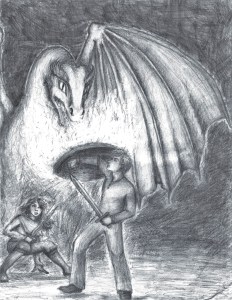
008Dragon fury2

Can you think of happy ending that did not include a Restoration? Go ahead, try, I’ll wait…

Anime is rife with this theme of Restoration. Usually it is through defeating the Big Bad at the end of the arc, and the land will magically heal. I watched the Naruto Movie: The Stone of Gelel today (It had the best boys in it, so I thought why not?), and it had the same thing, the trope where the land is healed all at once.

The Lion King has it too, though its over several months in that one.

I know I have readers from outside America, I may not know them, but you’ve definitely already got stories in mind that end this way. Every culture does.

In fact, it’s been noted that there is really only one basic plot in writing, even in nonfiction writing.

A problem is introduced, and a way to fix it, to restore us back to some ideal.

C. S. Lewis’s Pilgrim’s Regress is actually based entirely on the idea that any going forward, morally, is a going back. In it John, the Pilgrim, travels his land in search of an Island that ends up being the back of a mountain by his home. He comes full circle.

That is what the Eastern idea of Cyclical time is really about, that everything returns to its initial state, (we just disagree about what that state is.)

The important thing to understanding what the Restoration was is to keep in mind it can be either a symbolic physical act in the story, or it can be an emotional restoration, even a spiritual one.

Some stories will have a healing, where someone will have a physical problem fixed. Breaking Curses, undoing creepy science experiments, remedying a plague, all that falls under this category.

Other times the restoration will com in the form of finding a family member, finding a homeland, finding a title or position.

It’s more widespread for it to be an emotional restoration. From romances to kids shows, that restoration has to happen. Someone finds true love, remembers what’s important, learns what it is like to be human, learns the power of a certain virtue. And it restores them to who they are meant to be. Often who they once were, at the beginning of the tale, before the bad events took it from them.

Isn’t that what we all want in our lives, some of us want to be able to want it again.

All of us have an idea of a good life that we once had, or could have had, and we feel we missed it.

We’ve been told that the good life is in the present, yet we want to go back still. Be young again, be married again, have kids again, have that job again, like that thing again.

Like constellations imploding in the night; everything is turning, everything is turning, And the shapes that you drew may change beneath a different light, and everything you thought you knew will fall apart, but you’ll be all right“–The OH HELLOS, Constellations.

galaxy-sky-stars-Favim.com-192527

Today is the last day of 2019, how often have we thought that this year? Or in previous year’s. Maybe we had a good year, but even in happiness there is often a nostalgic feeling, at least for me. Like “Ah yes, this is how I used to feel.”

But when I was a kid, I wasn’t often happy. The nostalgia is an illusion. I am really wanting to go back even further. To a different time, one before I was even born.

20160211_083516

But those ages had trouble too. I’ve read enough to know they felt the same.

We have to go back further still, before the Fall.

Stories communicate that in their own way, by settling on one disaster that really changed it all for the worse, and must be undone. On Naruto, it was the battle of two friends, and two brothers, that begun the whole freaking mess. Supposedly it is undone by Naruto and Sasuke coming to peace. Rather like Cain and Abel.

In real life, people rarely narrow it down to one thing that’s wrong with the world–or their lives. You could list a half a dozen right now, if I asked.

As Rich Mullins sang “Everybody’s always saying they need just one thing, but what they really mean is they need just one thing more.”

In stories, a value like love, friendship, courage, or honor, tends to be the One Thing we MUST NOT LOSE EVER, AT ALL COSTS.

I’d like more things to be good in the world, and my life, sure. But I’m with Mullins. God is my One Thing.

To wrap this up, I guess my final point is that at the end of the year, the end of the story, the real question is: What is that One thing you need restored to you? Or maybe you need to be restored to it.

images (2)

To find a new thing is to find an old thing.

Well, I hope you enjoyed this send-off post, it’s been an interesting year for me, and I wish you the best in 2020. Happy New Year everyone⌚⌛☺–until then, Natasha.


Death= Redemption.

I got the idea from this from a comment conversation I had under my last post. I have been thinking about writing it for a while, so let’s talk tropes.

Although this trope is not exclusive to anime, as I’m sure all of us have seen it in movies and shows, anime uses it a lot.

Correction: anime pretends its going to use it a lot.

All us weaboos know the annoyance of animes that pretend they’ll kill everyone all the time, and then never kill anyone…except that one person you were kind of rooting for to make it. (sniff, Pyrrha.)

Then there’s Death Note where everyone dies.. (I don’t watch it.)

Well, I don’t care if nobody dies, I just hate being lied to and faked out so many times.

Naruto is almost sadistic about killing characters, it will inform you a character died a whole two or three seasons in advance, and then bring in the character later for a side arc, or flashbacks, and show them being cute and lovable and ready to actually be happy…and then they show your them dying, alone…(I’m still salty about The Bubble Guy Utaeka, I think.)

But, sometimes villains die, and they might stay dead, and then you have the redemption arc.

Anime accomplishes the arc part usually with flashbacks, while American media tends to either show you the villains in the beginning of the film and hint at a possible redemption, or maybe drop small hints throughout the movie or show, and then they have the death be a surprise.

Anime rarely makes it a surprise, by the  time they’ve actually died you’ve been watching for like, three episodes, or seen half a dozen flashbacks dragging it out.

Anyway, before I get into the meaning of it, I wanted to point out that not every redemption death is for a villain. Sometimes it’s a good character who left the fight, screwed up royally, or never committed to actually helping until that point. They aren’t a villain, sometimes they are a chaotic neutral, if you will, but they choose to sacrifice themselves and end up a hero.

The most infamous example of this in America may be Darth Vader from Star Wars, everyone loves that redemption moment of self sacrifice.

Often in kids media, its common that the character not actually die. In The Little Mermaid, Arial’s father sacrifices himself without dying exactly, (but I always found it much more horrifying to be turned into a worm-thing than just straight-up dying.) Or they will appear to die, but end up being okay.

Anyway, the kinds of characters you’ll see get a redemption death are usually villains who were shown to have a human side, maybe a person they still loved, even more likely if the person is the hero, take Thor and Loki’s back and forth relationship in the Avenger movies; another common one is bad parents who couldn’t seem to get it up until then, but show they love their kids by dying for them (Darth Vader); also the mentors or sage characters who failed to stop the villain make a sacrifice to give the heroes more time to figure it out. That’s even in The Lego Movie.

MHA has used this trope in a slightly different way, equating losing your powers with dying, for a hero, in a way. Thereby adding a weight to their fights that actually has a longer lasting impact on the show itself, not just the characters, because it means they can no longer use that character as a fail safe.

So why is this so  common?

The simple answer is that it’s easier to use death to create sympathy for the character and often it just doesn’t seem practical for a villain to survive, they would just go to prison or die anyway, why not let it be a blaze of glory instead?

But mechanics aside, I think there’s a deeper reason this is used so often.

The thing about tropes is, people mock them, but the reason they are so common is because they reflect meanings about real life that people feel to be true. Romantic tropes mirror what happens in real life, Chosen One tropes mirror the feeling of purpose we all want to have, and fallen Hero tropes mirror the knowledge we have of our own human weakness.

The Death=Redemption Trope is no different, it mirrors a feeling human beings have that death is somehow the only thing that can make up for our sins.

The Bible says “without the shedding of blood, there is no forgiveness of sins.” For thousands of years that meant animal blood, so that people could be pardoned. After Jesus came and died, His blood was enough to cover all men throughout time.

Fiction has felt this truth, whether the authors admit it or not, and that is why villains die so often to redeem themselves. somehow death seems to be the only way to blot out the memory of their evil.

Anime is interesting here, because as I pointed out in my last post, it has many bad guys who end up living. And without fail, those bad guys feel they must atone for their sins.

See, when the death part does not happen, the good guys are faced with the much more complicated problem of still remembering what the bad guys did and having that reminder in front of them. Even if the bad guys are sorry, the good guys may have a hard time seeing past that, sometimes they do not want to. Like Katara with Zuko on Avatar.

If the villain is dead, you can’t punish them anymore anyway. Only rarely will a character obsess over not getting to kill the villain.

Plus, dying for someone is just so hardcore noble, that it can challenge the heroes to think maybe the villain was never as evil as they thought. a lot of shows choose to later reveal that the villain did some good things along the way, often that they even help the heroes by leaving clues as to how to solve future problems.

Naruto did this with Itachi Uchiha…I hated it…

Now that I’ve discussed why this is so common, the better question is, does it work?

IS it good to send this message?

The answer is yes and no.

While death=redemption can be a beautiful way to symbolically show how we need to die to our sin, and how “greater love has no man than this, that he lay down his life for his friends” (-Jesus) there is one problem I see with it.

The whole point of fiction is to be symbolic. Sometimes when shows try to break down too much if death really equal redemption, then you have to start being more realistic.

The discussion then becomes “Should you have to kill yourself in order to be redeemed? Isn’t there a better way than that?”

Fairy Tail did this over and over again, and nearly always concluded on the side of life. But one time, at the end, they had Irene, the mother of Erza, kill herself because she did not trust herself and wanted to prevent herself from falling to the temptation to use Erza or her friends again.

When this happens it’s similar to Jesus telling us that if our right eye causes us to sin, pluck it out. If you really jsut cannot control yourself, then it’s better to lose an eye.

The bible is not saying self mutilation is a good idea. It’s saying that if we view sin that seriously, then we will put that kind of effort into getting free of it.

But we do not have to die fro our sins.

In the real world, this questions is also prevalent in our legal system. Should we just imprison people? Or should we kill them? Can’t anyone be redeemed? The real thought behind the more merciful system in America is that men can turn their lives around. But some men don’t, so we still need the Death Sentence.

Of course, Christians know that men on the verge of death for their sins have been saved, the thief on the cross is the most famous example. It happens nowadays too, in prisons and hospitals alike. But they still die.

The Bible does not seem overly concerned with whether men die in the body or not, as long as they are alive spiritually. That is, it is pro-life, but holds biological life as second in importance, if you follow God. And if you die immediately after accepting Christ, you are not the loser by any means.

Basically, with God, no one has to die for their sins, but some people still will because men cannot know for certain when there’s a change of heart, but that death is just of the body and not seen as a punishment to the christian anymore.

That said, you could say Death=Redemption really hangs on how well the villain understood why they were changing. You have to feel that, had they lived, they would have kept changing, not that they died out of some unhealthy, spur-of-the -moment, self hatred.

Dying for love is the preferred reason. And the one that reflects the most what Jesus did for us.

Though nonchristians may deny that, I don’t know anyone who hates this trope. It seems to be written into our psyches to see meaning in self-sacrifice. I know a YouTube reviewer who will give a movie a win every time there is a self-sacrifice in it.

Death is a tricky subject in fiction where death can be undone. Or prevented in ways we in the real world can only dream of.

Did they have to die? Does their death truly atone for their sins?

Death is all that can atone for sins, but yet, if they keep on living, can they live free?

Most often the answer is, they have to learn to love, to be a good person, to change.

Christianity ties these two things together by having a way to die before you die, to die to your sinful self, and to live in Christ.

As crazy as that sounds, the proof is in the pudding, more people become good because of Christianity than any other reason I know of. Throughout history, the bad kids, the rebels, the slaveholders, the cruel, the arrogant, have made 180 degree turns because of Christianity. Whole countries have changed over it. They still are.

In closing, there was one time Naruto did something with this idea that I thought was profound. When Gaara, a former murder/demon possessed person tried to learn about love, he later got kidnapped and killed in order to steal his power. He lost the demon (thank goodness)but also his life. But then a woman who had stuck him with the demon to begin with gave her life in order to resurrect him, with a little help from Naruto himself. Gaara is essentially given a new life, someone else’s life, and able to live free from then on. No longer needing to worry about losing control.

Easily one of the best examples I’ve seen, up there with Frozen.

Until next time–Natasha.


Anime Bondage: Fairy Tail

It’s been awhile…hey. 😁

Well, I think anime fans, sorry, weaboos, might laugh at me for using Fairy Tail as an example in this series.

I’ll admit Fairy Tail is on the lighter-hearted side, this is more about an anime trope that fairy tail introduced me to, but I’ve since realized is common.

It’s really pretty sad how common it is, and unquestioned.

For lack of a better term, I dub this trope the “I am too much of a sinner to be happy.”

In Fairy Tail, the character who fell under this trope was Jellal, who also happened to be criminally underused, and the other half of one of the better ships.

Saltiness aside, I was a bit surprised.

As someone who’s grown up on American media, and English Fairytales, I expect happy endings, pure and noble characters, and positive messages.

While anime features characters so relentlessly good they’d almost meet George MacDonald’s standard of the “common good uncommonly developed” it is a lot darker as a rule than our stories. Happy endings are hard come by and can feel rushed and incomplete compared to the rest of the story.

I started to like anime because it showed very real problems and made love and goodness the answer to them.

But I started to get frustrated the more I realized anime is incomplete also.

Here’s the skinny on Jellal if you don’t know:

Jellal is a villain in season 1, but he’s being controlled by another character. he began as a very brave, kind, and noble boy of around 8, and in a moment of weakness to hatred, was possessed by dark magic from a different villain looking for a victim.

Jellal goes on to try to kill all his old friends, and resurrect the Black wizard Zeref, causing a lot of pain and suffering along the way.

Later he survives being blown up (like you do on anime) and loses his memory. he meets his love interested again and tries to prevent a catastrophe. Then gets arrested and imprisoned. About 6 years later (time skip) he gets out and forms a group of former villains turned good guys to try to atone for their sins.

At this point he meets up with his love interest, Erza, again, and turns down her offer of a relationship and forgiveness. Telling  his new friends that for someone like him, love is out of the question. Love and happiness.

He then spends most of the show running from just that, and treating his own life as negligible. At the end he is told he should try to live to make Erza happy. We’re given a hint that he intends to do this, but it’s not shown.

Now, I’m happy it worked out in the end…but the pattern went on for a long time. It’s gone on longer on other animes. Including freaking Naruto (almost done with that finally.)

The reason I would call this attitude of self-inflicted punishment bondage is because it does not even work, even if it were acceptable.

No one ever changed themselves by punishing themselves.

I’m more concerned with how unchallenged the idea goes on anime then that it appears in the first place.

It’s even on my favorite MHA when Iida chooses to leave his hand injured until he can deserve healing.

It’s a very real struggle people have. My dad is one of them. In the past I’ve wondered about it myself, if I need to punish myself for things.

I remember it was humorously explored in one of the Anne of Green Gables books, the 7th one, Rainbow Valley. Where four children elect to bring themselves up by implementing rather creative punishments whenever they do something wrong. It does not work.

Interestingly, the Bible has strong words to say about people harming themselves, and treats the idea of self punishment as rather abhorrent.

1 Corinthians 6:19-20 “Don’t you know that your body is a temple that belongs to the Holy Spirit? The Holy Spirit, whom you received from God, lives in you. You don’t belong to yourselves. You were bought for a price. So bring glory to God in the way you use your body.”

Leviticus 19:28 “You shall not make any cuts on your body for the dead or tattoo yourselves: I am the Lord.”

In 1 Kings it says of the prophets of  Baal “And they cried aloud and cut themselves after their custom with swords and lances, until the blood gushed out upon them.”

This worship practice is not something you’ll find God telling His people to do.

Now, we are sometimes told to repent in physical ways, dust, ashes, sackcloth, fasting, but there is no health damage in any of this.

The same applies to emotional damage. Making ourselves miserable is discouraged by the Bible.

In speaking of guilt, Paul says “Godly sorrow brings repentance that leads to salvation and leaves no regret, but worldly sorrow brings death.” (2 Cor 7:10).

After repenting initially, we are supposed to receive God’s forgiveness, and give up thinking about our sins.

We no longer need to be haunted by regrets.

The reason for this is that God takes even our mistakes and uses them, once we’ve repented, to bring us into more freedom. We have to take sin seriously in order to want to be free of it, true repentance is not wallowing in guilt, but acknowledging how serious sin is, then trusting that God can deliver you from it.

There are many christians haunted by regrets, but that is not biblical. Some churches have taught it because they misinterpreted the teaching of the bible…or ignored it.

In my experience, actually, it’s not the chruches fault. A christian chooses to live in regrets.

I have had, since becoming a christian, been mostly free of regrets. Early on I embraced the idea that I do not need to beat myself up anymore about my past.

Probably because I watched my dad live that way for years, and saw how little good it did, and then had to deal with him imposing that on me because we treat others how we treat ourselves.

I let my past go, I only wished he’d do the same. I still do.

And so, when it comes to the self-punishment thing, I just can’t get on board.

From a logical standpoint, nothing is really accomplished by choosing to keep yourself either injured, or emotionally empty.

One might say ” I do not deserve love.” But welcome to the human race. None of us do.

Love is not about what you deserve, it’s about what you need to be a full person.

Jellal never has much success atoning for his sins while he is doing it out of guilt, the few times he does it out of love are when it ends up working out. Contrast it to Erza, who learns earlier to start forgiving herself and living out of love, and has success after success against impossible odds because love’s power fuels her.

The bondage of guilt is one any honest human being has to face, but we do not have to stay in it. God’s forgiveness sets us free if we just ask it.

And human forgiveness is good too. Honestly, more people need to learn to accept each other’s forgiveness and quit worrying about it.

Perhaps I leaned more on the christian side for this, but I can’t separate my idea of forgiveness from my faith.

Christianity is a very free religion in that way. The only one I know of that says guilt can be completely gone, that you can no longer require punishment, and can live free and happy no matter what your past is.

Until next time, stay honest–Natasha.

Bringing people back to life.

“Was it you ‘mid the fire and the ember? Were you there to bedevil and beguile?

See, your face isn’t quite as I remember, but, I know, that wicked shape to your smile.

Bury me as it pleases you, lover, at sea or deep within the catacombs,

but these bones never rested while living, so, how can, they stand to languish in repose?”

(Where is Your Rider, The OH HELLOS.)

Today I want to jump right into a rather unusual topic for blogs.

This began for me by thinking of one of the shows I’ve given my patronage too, that is RWBY.

I have my issues with it, but last year’s season brought some new ideas to the table.

Namely, one episode that raised the question: Is it okay to want people to come back from the dead?

You know, as much as people like to tell you that we’re all entitled to our own opinion, and that we don’t need to talk about it if we have differences, and that we should focus on our strengths, yada yada, I never see so much engagement online or in real life as when it becomes about a moral or religious question (if they are really different, which I doubt.)

A lot of people’s comment on this episode is that death must be accepted and why should one person get what millions of people do not get.

Some people think, it’s no big deal, can’t gods (or God) being people back to life with a snap of the fingers, why not just do it?

Some say, the person has to be worthy of being brought back. It gets real twitchy at that point.

Well, as Christian, I found this debate rather interesting. All religions address the idea of life and death, most of them address the idea of whether people can be brought back to life.

Egyptian and Greek Mythology famously contain myths about trying to bring back dead people or dead gods.

What’s funny too, is that almost every religion gives some reason why people must die and stay dead.

And most modern interpretations of the issue feel the need to justify why people must stay dead.

Even though, strangely enough, the idea that resurrecting people is possible is everywhere. Even through time travel, as the least magical or mystical way to achieve it (sort of).

Have you ever thought about it?

The great writers I’ve read have all encouraged me to think more seriously about ideas that are common to almost all people. Why do we dismiss the things everyone wants, everyone thinks about, as wishful thinking?

It would be more sensible to ask, if this desire shows up everywhere, like hunger and thirst, shouldn’t there be a reason for it?

Grief itself is proof of it’s own strangeness.

Grief is universally shocking. That’s one of the first emotions of it. When we lose someone, even a pet, even a plant, we are stunned.

Even in war times when it was likely, we are surprised.

And we wish it didn’t have to be so.

So when it comes to the idea of raising the dead, it seems to taunt us in a way.

Shows, especially anime and magic-based shows, are very fond of bringing up the issue almost in mockery of the bereaved.

Like bringing back characters who we wish could stay alive, but in ways that make it impossible to be happy. They come evil, they come back because of some terrible crime, or they come back but don’t remember who they were.

That dream of resurrections isn’t truly achieved.

And usually the other characters have to let them go back to the afterlife. If there is one on the show or in the book.

In myths, the idea of bringing back loved ones tends to backfire. Like, you’re messing with nature.

Odd, considering resurrection is actually a part of nature.

The process of reproduction is basically a resurrection in of itself. Let alone the stories all of us have heard or read of recoveries that don’t make sense, out of body experiences, people coming back to life after being declared medically dead.

Death is the most unnatural part of nature.

At least if you believe the Bible.

Skeptics might look at the Bible and declare that death is part of the ecosystem, that we could not survive as a species if we did not die, if animals did not die.

But they assume two things, one, that the ecosystem we have now is the only one we could have.

Two, that the world is the same as it always was, which the Bible claims is not true, that at one time our resources were far greater.

Lastly, though the skeptic may laugh at this, it’s a bit stupid to think that God who made all things could not replenish the earth if we exhausted our resources. He already does that.

The same with death, really. If things do get worse over time, it really doesn’t matter. The bible says God renews youth like the eagles.

So that death happens is strange. But that it is irreversible would also be strange.

Why on earth would it be?

Death, according the Bible, is the offspring of Sin. No sin=no death. The God who could remove sin could remove death also.

We still die, naturally.

Christianity, it’s been pointed out, would be a hopeless religion if Jesus did not raise the dead.

It’s odd that the thing many religions are afraid of, and modern writers tend to treat as an abomination, as a weakness of the person who refuses to let go, the Bible treats as barely an inconvenience.

In both the old and new Testament, raising the dead requires less time and effort than climbing a mountain; phases people less than the voice of God; and barely even shocks them, after the initial amazement.

Elijah raised a boy from the dead, I think Elisha did also, Jesus raised at least three on record, probably more, Peter raised one. Paul presumably was raised from teh dead by God. And Jesus Himself of course.

It doesn’t even seem to stun these people.

What’s hilarious, if you’re comparin it to how we treat the subject in myth and ficiton, is that when the dead are raised in the Bible it’s never for them. Never based on what they deserve.

Because, you see, if they were in heaven, they are far better off, and it’s ridiculous to talk of deserving to return to this messed up world.

If they were in hell, clearly they didn’t even deserve earth.

Nope, every time it’s for the bereaved. The very thing RWBY, other shows, and myths all decry as the worst reason to resurrect someone, is the only reason the Bible does so besides just straight up God-force, like when Ezekiel brought a whole valley of bones to life, and saints resurrected after Jesus died. (Google it.)

Jesus raised Lazarus for the sake of his sisters, Peter raised Dorcas for the sake of her friends, Elijah raised the son of the woman who sheltered him for her sake.

Is it selfish to wish people back from the dead then?

That’s the idea behind telling people “Why should you be any different from anyone else?”

Funny thing is, the Bible abhors that idea.

The Bible’s question to all men and women is always “Why shouldn’t you be different from everyone else?”

“All men die, few men ever really live”–Braveheart

Why should you sin, and die, like all men? Why not seize onto the offer of Christ, as anyone who reads His word is given the chance to do?

Well, the goal of Christianity is that we will all be saved and so share the same fate, but at the very least, you yourself should be saved.

When you consider that life is the normal state of things, it is not remarkable to want people back from the dead. Death interrupted them.

One zany anime has coined this feeling exactly, you probably can guess, if you’re an anime person, that I mean Dragon Ball.

Dragon Ball classically treats death as an inconvenience that is remedied multiple times even for the same character. People joke that death has no consequences on that show, like that’s a downside.

But the Bible teaches exactly that. “O Death, where is your sting?”

The idea most ridiculous to most people is that death does not have a sting anymore, that it could be a nuisance, not a tragedy.

But, hell is the tragedy. Our bodies dying is a inconvenience.

Before I end this, I suppose I should answer the question as to why people still die.

Christians, specifically, since we are the ones who claim we will live forever.

The best answer I have, and I am no expert, is what Paul says about the corruptible putting on the incorruptible.

The body, because we’ve had it while sinners, is corruptible. Many health issues come for sin, a lot of death comes from sin. Jesus, in a mortal body, died.

Mortal bodies pay the price of sin, whether it’s the person’s who has it, or someone else sinning against them.

After all, if they did not, sin would be a minor problem also, or men would at least treat it as such.

But, when we die, as Christians, the Word says we change this body for a new one. We are not ethereal spirits floating through space, we remain ourselves. Our body is a tent, Paul says, one we will upgrade eventually. The body is the last part of oneself to be redeemed form death.

The reason is, God starts form the top, Spirit, Soul, Mind, and Body is the least important part.

That’s to the  best of my knowledge.

Yet, if Jesus had not raised the dead, I’d be foolish to trust that idea. WE must know resurrection is possible before we can trust ourselves to be resurrected after we die.

see, the Faith of the Christian all comes down to this: Are we willing to be resurrected into a different world? Are we willing to leave earth and accept heaven?

It sounds like anyone would, but heaven is scary. IT’s unfamiliar. There have been christian hesitant to go there.

Some people joke about going to hell because all their friends will be there.

Well, that may be, but it wouldn’t comfort you.

Hell is as unnatural to us as heaven, the only difference (other than torment) is that Heaven is not isolation, and so we will have help. While Hell is isolation, utter and total. And if you know of people there, it only make it worse. (See the story of the man who asked Abraham to warn his brothers not to go there.)

It’s a smaller matter to be raised to lif eon earth, that’s a return to an old form, but to be raisedin heaven, it’s going to be different.

That’s why old stories and new stories often do not go far enough. They ask if we should want the dead to be raised, but they never ask if we should want the dead to come back stronger and better than before.

(Except Dragon Ball, that old show really just hit it by accident, didn’t it?)

Lastly, this is one example of a very real truth: That Christianity is not about accpeting thins as they are.

It is about knowing things are not the way they should be, and doing soemthing about it.

IT is dangerous how much the idea of acceptance has crept into the church, and the culture around it. Sure, we should accept people initially as they are.

But we should not accept that thins will never change, because they will. It’s just a matter of whether it’s for the better or worse.

Either you are moved by the world, or you move it  yourself. Archimedes had the right idea.

Image result for archimedes move the earth image


Until next time–Natasha.

Those who make them are like them.

I have another post about abuse today.

It won’t be especially sad though. Today I have more of a thought “Why does abuse happen?”

There are many, many reasons, I couldn’t possibly address them all.

But for a christian family like mine, I believe there is one reason that can be common. It’s not the only reason, but it’s an important one to understand if there’s ever going to be  road to healing.

That reason is Idolatry.

Idolatry is a fancy sounding word for one of the most common sins to man, that of worshiping something other than the One True God.

Even if you are not a Christian, it’s probably no strength for you to agree that there are things worth devoting your life to, and that many people do not devote their lives to the right thing, so if the religious term throws your off, just think of it like that.

Idolatry is just easier to use for me, since it’s one word, but in Church we usually call it False Images, False gods, or just Idols themselves.

In my family the False Image was My Family itself.

My dad has long been obsessed with being a better person, but his version of better was rather vague and unrealistic. It usually involved ridding himself of his faults as a parent and husband.

But his biggest faults in that regard was simply focusing on the flaws. He didn’t prioritize us ourselves, but this idea of what our family should look like.

Our family should have its own ministry (one he approved of)

Our family should make music

Our family should be more hospitable

Our family should all go tot he same church.

Our family should be a witness to the extended family.

He never took into consideration that maybe it was not his job to decide how we should serve God.

I am aware of  the Bible’s teaching about a whole household serving God. However, it never says everyone in the house should do the exact same thing. In the New Testament the control of family is a little lesser, since may early Christians did not have their whole family’s support.

It didn’t stop with Church stuff anyway. That was just what annoyed me the most.

Maybe you’ve had the same experience with your relatives.

My dad would also say repeatedly that our family was the most important thing to him and he got his happiness from us.

Which bugged me, I thought “We get our happiness form God, not each other.”

Not to misunderstand me, people can greatly increase our happiness, but it does not spring from them. If it does it’s fleeting, people die, they move, they move on, they ditch us, not all of them, but human based happiness is just not permanent.

It sounds like a Christian Cliche to say We Get our Happiness from God.

Oh, we’re so spiritual, right?

I know, but it really is true. It can be misused sure, to hide real problems, but so can most things.

It’s not that God makes me feel happy all the time, it’s that when Id o feel happy, it’s in God. I know it is from Him, and it is a gift.

By the way, there’s been a teaching in the Church that says the Bible never says “God wants you Happy”

Let me set you free if you’ve heard this: That is bull-crap.

No, you won’t find the exact words “God wants you happy” in scripture, the Bible prefers the words “Joy” “Rejoicing” “Praising” “Thankful” “Peaceful” “Exalted” and “Satisfying the desires of your heart.”

All that is stronger than happiness as a chemically induced fleeting feeling, though that too, because God also wants you healthy, and a healthy person will produce that physical feeling of happiness too.

I digress.

My dad used our family as a false god. Like all idols, it had to be removed from him for him to turn back to the real God.

And we had also to give up serving my dad’s happiness, instead of serving God’s. We wanted our dad to be happy, sure, but we could not keep trying to fill the void of God in his heart.

And we could not let him punish us with emotional abuse for inevitably failing to do the impossible.

It struck me what the Bible is talking about when it warns about idols.

You are what you adore, what you trust in, you become.

If you trust in a lie, you become a liar, and eventually, if you fall in with C. S. Lewis’s point of view in The Great Divorce, you become a lie itself.

If you trust in money, you become a miser.

If you trust in drugs, you become an addict.

All these states of being are merging you with the thing you worship. In the case of drugs it literally will get worked into you bloodstream, your DNA, and your brain engineering, and passed on to your kids.

“Their idols are silver and gold,
The work of men’s hands.
 They have mouths, but they do not speak;
Eyes they have, but they do not see;
They have ears, but they do not hear;
Noses they have, but they do not smell;
 They have hands, but they do not handle;
Feet they have, but they do not walk;
Nor do they mutter through their throat.
 Those who make them are like them;
So is everyone who trusts in them.” Psalms 115:4-6

“They have mouths but they do not speak; eyes they have but they do not see; they have ears but they do not hear; nor is there any breath in their mouths. Those who make them are like them; so is everyone who trusts in them.” Psalms 135:16-18

That’s why we are all sinners, by the way. Adam became a sinner, and in a way, he became sin, and so we carry that in our DNA now. We are born in sin, as the Word puts it.

Jesus became sin for us, the Word also says, in order to finally get Sin out of us. He killed sin by becoming it, and then dying.

The Bible also teaches that the Spirit of God is able to divide soul and spirit, and that is how we are saved from sin. God can separate the sinner form the sin.

We ourselves cannot do that, except by loving the sinner. We cannot transform them. But loving people will help them choose to be transformed.

In summary, I think almost all abuse happens due to idols

Many abusers are addicts, after all. All of them put power above God, certainly. Abuse is all about feeling powerful.

It’s important to keep in mind that focusing too much on being abused also can be a form of idolatry. God wants us to be healthy, and if we focus on him, we’ll start to heal. If we are letting Him help us.

But don’t wear your sorrow like a badge of honor, Paul boasted of his weakness because God was glorified in it, not because weakness all on its own is a glory.

One last thought

All of us are meant to be at rest, and to rejoice. Abusers and abused alike. However you handle your past, whatever you went through, even if you were the abuser in some ways, don’t think it mean you cannot ever be happy,

Happiness is not what we deserve, desert does not come into it at all. It’s the natural state of things. You can’t earn it because you were created for it, it’s just like putting a key into a lock. No question of deserving it, it would be stupid to ask that.

So, it’s okay to move on. Really.

And that’s all I got for you today. Until next time, stay honest–Natasha.

Pure, Abundant, and Long Suffering Love–More we can learn from Gray and Juvia.

The other day I wrote a post about one of my favorite ships and I touched on some subjects I thought it would be nice to expand on.

Here’s an excerpt from the post Stand By You that contains what I wanted to talk about more:

“But Juvia acts out of her strong love for Gray and manages to convey a lot without knowing she’s doing it. She fights for him, and is always there whenever he does choose to open up. Sometimes it’s simply that she does the right thing by accident that seems to mean the most to Gray, because she wasn’t trying to make him see a point, she just honestly wanted to help.

There’s a time to teach someone, but there is a time to just be there, and love them however you can.

And I like the additional message that love is messy and we aren’t smooth about it all the time, but our honest efforts rings the most true to people.

It’s beautiful. And its not something you have to be an expert on relationships to do, that’s the great part, you can start off knowing nothing, and still be able to do this.”

What I mentioned here was that Juvia and Gray are not really experts at love.

That gives me hope at least, because I am far from an expert at love.

I write about it a lot, I talk about it, I can give theories and examples, but at the end of the day, love is what you practice, not what you preach.

I’d like to talk about a couple different aspects of love this ship made me think of, and that I’ve also noticed in my own life.

First, Love is Pure.

Love has to be pure, first and foremost, or it will be hollow.

In my own life, I have a parent who is great about saying he loves me, giving me all kinds of praise, and verbal affirmation.

And he would berate me for not being satisfied with that.

Red flag, by the way, to anyone who does this with someone they know. If you are criticizing someone for not receiving your praise…that’s part of the reason they don’t receive your praise. It’s a bit of an oxymoronic thing to do.

The reason I didn’t like my father’s praise was that there was nothing behind it. He might call me good things, but he didn’t know any of the good things I really was. He didn’t often ask me about my life, and when he did, if I told him, he’d make the conversation about something he wanted to talk about.

He didn’t know what I liked, or what I hated. He didn’t know who my friends were, for the most part.

And, he wouldn’t do anything to back up those words.

My father’s love was not pure because it was not honest, it was based on an idea of himself and me that wasn’t accurate. And if I did not line up, I would be punished with coldness or criticism.

I find this is too common in human beings. We tend to want things on our terms when we give love. We’ll go so far, and no further. If it’s not received well, we pull back.

Juvia, on the other hand, is never daunted by how well she is received. To the point where you might almost call her inconsiderate. But not really. If you look more closely you’ll notice Juvia does not ever put more on Gray than Gray can handle, even if it makes him feel a little awkward, he’s not mortified. If he shows it bothers him, she’ll pull back a bit (in most cases, as I mentioned, the show uses it for humor.)

Second, Love is Abundant

Juvia pours her whole self into loving in the wonky way she does. It’s not always graceful or subtle, it’s extravagant, open, and overwhelming.

But, deep down, doesn’t every person want to be loved that way?

The truth is, if you don’t like being loved like that, it’s certain you have issues.

I don’t say that to judge, since it’s one of my own problems to not receive love as well as I wish.

We were made for extravagant love. In fact, as the Bible describes it, there is no such thing as love that is not like an ocean, an all consuming passion. The Bible doesn’t call a fleeting fancy love.

Love may not be a feeling always, but even the action of love is a full on commitment. Whether you feel the warm, fuzzy stuff, you are supposed to pour yourself out however you can.

Paul wrote of his ministry “I am being poured out like a drink offering.” (2 Timothy 4:6)

David also said “I am poured out like water” in Psalm 22:14, which is a prophecy of how Jesus would pour himself out on the cross, the highest act of love.

Fitting that Juvia’s power is literally being water.

It is daring to love in this manner.

People are broken, many more so than Gray, and they rarely know how to accept love, let alone how to return it.

And that leads to the third thing: Love is long-suffering.

Juvia waits a very long time to get what she wants, at least when you’re in love, it feels like a long time, doesn’t it? And yet, it also doesn’t.

In Genesis, one of my favorite Bible love stories is how Jacob worked 14 years for his wife Rachael, and the writer tells us that his love for her made it seem like a short time.

How valued must Rachael have felt, right?

Wrong, actually. Rachael had insecurities she took out on Jacob even after such devotion. She wasn’t satisfied with human love.

It’s just a part of life, that the people we love cannot be happy solely on our love, even if it makes them happier.

Jacob continued to love Rachael till the day she died, and treasured the sons he had with her more than his other children. In the end, he told her to take her problem to God, not him.

A wise thing to say.

Sometimes the best thing we can do for our loved ones is to stand by them and let them go to God. Something my family has implemented with my dad lately.

Juvia also does this for Gray. She wishes to be able to help him at all times, but sometimes she has to trust him and do her part in other places.

If you’ve noticed I’ve used only Juvia for an example here, well, she’s my favorite.

But Gray does bring something worth mentioning to the table also:

Gray, like many men, and many women, does not really understand Juvia all that well at first and makes plenty of errors on that account. He also does not know how to respond to her love, and often tries to push it away.

But the thing Gray does right, that is beautiful in its humility, is stick around for it.

Instead of avoiding Juvia, Gray spends time around her and gradually learns to be more receptive. He is uncomfortable without being dismissive entirely.

And the thing is, as flawed humans, if we’re totally honest with ourselves, sometimes our most loving act is simply to hold still and let ourselves be loved.

Most especially with God, but I’ve hurt people by pulling away from their embraces, and I know I’ve been hurt by people rejecting my efforts at loving them.

I know that sometimes I really do have to force myself not to run, sometimes all I can do is sit there and just not run. I may not even be able to ask for what I need, but I can stay, and give someone the chance to help me.

Gray screws up a lot, and he feels ashamed… but in the end, he lets himself be comforted and adored. He probably can’t express how grateful he is, but he accepts it as much as he can.

A little tip to guys, if you have a decent girlfriend or wife, than the most kind thing you can do for her sometimes is just let her take care of you. It’s like magic in a woman, we feel better when we do that. Even if you don’t feel like you need it, let her do it.

I’m guessing some men feel the same way. (Obviously I don’t mean being condescended to, I think most people can tell the difference on their own.)

There is so much more to say, but I don’t want to make this too long.

I think I covered the central part anyway.

Something I apply to myself, I want to keep on loving even if I’m not requited. Even if the kind of love I feel has to change with the situation, the point is never to stop loving.

I may talk about that more another time, but for now, stay honest–Natasha.