The Element of Wisdom–2

My sister suggested I do a follow-up post about Wisdom in stories, and after looking it over, I do think there is more to say:

I used Pyrrha Nikos as an example of a wise character, and one who caused wiser writing decisions.  ( see post here –https://drybonestruth.wordpress.com/2019/07/05/the-element-of-wisdom)

But the question I didn’t really answer was What does Wise storytelling actually look like?

We know what it doesn’t look like.

Often, I think writers sometimes make wise decisions that are misunderstood by fans. Mostly by the nitpicking ones.

I’ve seen analysts actually complain that a story had too much of a message, and that it should blur the lines between right and wrong.

In fact, some fans are defending the new Star Wars movies on just such grounds, that they made it more grey.

It might be best to make a distinction then between worldly wisdom and godly wisdom.

Worldly Wisdom: It is wisdom that consists of knowing how to work the system, how to get what you want, how to climb and succeed in this society. How to not be duped by scammers. Worldly Wisdom can look like caution and common sense, but the one thing it can almost never look is Unselfish. Even when it says it is helping you, you are really helping it.

“Here we go again, give it one more try, don’t believe the system’s on your side”–Switchfoot, Rise Above It.

Worldly Wisdom can be good in small amounts (running a successful business is no sin,) but it must be tempered with other virtues, or it makes you into a selfish, arrogant, cynic.

Godly Wisdom: “The fear of the Lord is the beginning of wisdom” (Proverbs 8:10) this wisdom is based on knowing right from wrong. It focuses on the meaning of things.

“Do you ponder the manner of things? In the dark?”–Glitter and Gold.

Proverbs is the book of the Bible that talks the most about Wisdom, and it always connects it to being able to do what is right, and to happiness.

Interesting then, that Solomon, the wisest man in the old testament, also wrote Ecclesiastes. The most pessimistic book in the Bible. In it, he admits that he turned his heart from God, and found that every other thing was, in the end, empty.

He would have been better off living a simple, hardworking life, he thinks. Like the Happy Peasant, but even this, he says, is vanity.

Eccl 12:1, 8-11, 13-14 “Remember now your Creator in the days of your youth,
Before the difficult days come… Vanity of vanities,” says the Preacher, “All is vanity.”

And moreover, because the Preacher was wise, he still taught the people knowledge; yes, he pondered and sought out and set in order many proverbs. 10 The Preacher sought to find acceptable words; and what was written was upright—words of truth. 11 The words of the wise are like goads, and the words of scholars are like well-driven nails, given by one Shepherd.

 Let us hear the conclusion of the whole matter:

Fear God and keep His commandments,
For this is man’s all.  For God will bring every work into judgment,
Including every secret thing,
Whether good or evil.”

Solomon wrote proverbs and they were good, he says, but they are like goads to drive us forward and like nails that hold things in place.

Wisdom, one might conclude, is about limitation. Knowing how to control yourself, how to stay away form evil, having a compass.

There is something about doing right that I find very few people outside of Christianity seem to understand. There are traces of it in the idea that it is better to give than to receive, which people still embrace, but not much place else.

People in the bible speak of doing good like it is their greatest pleasure, David says he delights himself in God’s commandments.

People tend to assume this means being a prude, a stickler for rules, maybe even OCD about them.

But this is not about panicking if rules are broken. Rule lovers can be more stressed out than rule breakers, we all know that.

This is about literal joy in doing what is good. In knowing what is good.

I pity people who do not know what that joy feels like. It is no coincidence that this pluralistic society is also a depressed one.

Depression has always followed moral depravity, because people miss that Goodness itself is the greatest joy, and that is why good people are so reluctant to step out of it.

Think of your favorite show, and if it has a character that the fandom world calls “pure”, that character is almost always a happier, cheerful one.

Proverbs 8:35 says “For whoever finds me [wisdom] finds life, and obtains favor from the Lord.”

Proverbs also repeatedly says that wise children will make their parents rejoice.

Happy in the man who finds wisdom, and the man who gains understanding.” (Prov 3:13 emphasis mine.)

A hallmark of a wise character, or writer, is that they will bring gladness to the story they are in.
Pyrrha certainly did this, watching her made me feel uplifted about my own life.
A wise writer delights their readers with the rightness of their decisions. “A word fitly spoken is like apples of gold in a setting of silver.” (Prov 25:11)
Happy events come because of wise characters, or they speak comfort or inspiration to other characters that gives them strength to go on.
Wisdom is life: Wise characters are usually the ones who make the choices that lead to saving people.
It can even be saving their heart, as MHA says, it can be talking them off the ledge, talking them our of doing something evil.
Showing mercy where mercy was needed.
Wisdom also brings about justice: You know the characters who can lay a verbal smack down on someone who is acting up, can decide how to stop a problem, and can dole out a fair punishment, if they have to.
Wisdom is knowing how to handle people, but godly wisdom is knowing how to do this in a way that will promote their well being.
In writing, an author has to be unselfish. It can be easy to use our characters to make your readers happy, with zero regard for how much it actually helps the characters or the story.
Analysts complain about a lack of continuity in shows and movie series mostly because it services the author more than the characters to be inconsistent. I can think of a few times where ignoring the past and doing something different helped a story  *cough XMen *cough. But usually it doesn’t.


There is also pandering, which is a huge problem with popular shows. Especially in anime.

Fans can push for wise decisions, but a lot of the time they are only thinking about what they want, and not what is best for the story.

It may seem silly to say fictional characters deserve some consideration, but I’ve never noticed any discrepancy with how writers treat fictional and real people.

Charles Dickens was known to not treat real people very well, and his characters he treated even worse.

People who work at loving other people tend to write stories than incorporate that theme. Hannah Hurnard is one example. So is C. S. Lewis.

And my values of helping people be the best person they can be are certainly reflected in all forms of my writing, including this blog.

So when I say writers need to be unselfish with their characters and story, I mean it quite seriously.

img_1549-4

All this is wisdom.

Until next time–Natasha

Ladylikeness is weak?

I was just scrolling though a comment section for MLP and I found someone trolling people about feminism.

A little context: The episode is called “A Dog and Pony Show.”

It ends with Twilight saying that just because someone is ladylike, it doesn’t make them weak.

And there weren’t too many people harping on about it. In fact, I didn’t see any feminist comments, but I did see someone who was clearly trying to get some kind of reaction by calling it feminist and saying “Face it, ladies are weak.”

What’s funny? No girls were taking the bait, but one other guy watching did.

Now, I really think this is not most men. I somehow doubt this particular dude even hates women, he probably just doesn’t like feminism.

But I can’t help but think, feminists overreact all the time to pretty innocuous stuff, but I guess it can go both ways.

It makes me think of a Girl Meets World episode Girl Meets STEM, which a guy who reviewed it said had a feminist message. He wasn’t against the message, but I had watched it and concluded the episode was actually warning girls not to swallow the man-hating pill.

As a woman, I really can’t call it anything else. If I talked about men the way many of these feminists and their shows do, I’d conclude I hated them.

And let’s talk about this.

A lot of women become feminists because they had poor father figures who did not respect them, some come out of abusive households.

It’s just as likely to produce weak women, but I’d also argue that not all feminists are particularly strong.

I have to think of what my Mom said of one woman (it wasn’t a feminist by the way, just some girl on a survival TV show talking about having a hard life) who said her experiences made her strong, but then after two days of the challenge was KO-ed.

My mom made the observation that just because you survived something it doesn’t make you strong.

I’ve talked about why I’m not a feminist before. I believe in equal rights, same as any smart person, I would hope. But its’ for the same reason I don’t like Black History month, I don’t see the point of flaunting it.

Black history should be taught along with other history, as it makes sense in the curriculum, not set aside for it’s own month. If we gave every ethnicity its own month, we’d have a hopelessly disjointed curriculum, and unless we do that, we’re still being biased. Better to dot hem all together as it chronologically makes sense, then we can give everyone attention.

And I don’t seem the point of flaunting womanhood either. It’s not like it’s something you could control being.

I think the real reason for many women who really hate men and demand special treatment is that their father did give them the kind of treatment they should have received. Girls want to be treasured (so do boys) and loved, when they aren’t, they can become depressed or angry, or both usually.

I remember, I was angry. At age 11 or so, I got called out on it. No one tried to find out why I was angry.

Looking back, my problem, among other things, was that my dad did not pour into my life… he was hardly in it at all personally, though he lived at my house and my parents have a decent relationship. But my dad, the older I got, paid less and less attention to me. Unless I was in trouble. I think you know the story.

And I never did the things teenage girls usually get in trouble for. You’d be surprised how little it took to get me sent on a guilt trip as a young teen.

Even to this day that has not changed. But I changed. I’m not living in anger anymore.

And in full honesty, I have had my times of being tempted to put men into a box. I also know men have the same temptation with women. A lot of them have had moms who didn’t do so well with them, girlfriends who didn’t, and so on.

I suspect that they are just quieter about it. Now that the culture is more in favor of women.

I really don’t think it make one gender worse or better that we’re both tempted to stereotype each other, it just make sense. Once bitten, twice shy. You have one bad experience with a man, it’s easier to make all men the face of your problem. And vice versa.

The best thing to do is not to play into it. Don’t be what they think you are. Nevermind if they interpret all your actions into their image of you, if you know you are doing it, then that’s what matters.

Justice, I’ve learned, can come slowly, but it comes.

As for the question of ladylikeness being weak, I really think it’s obviously not true. The examples are getting rarer now that girls are encourage to act like bros, a thing that suits some women, and puts others at a huge disadvantage.

From my experience, ladylikeness is power. I’m the type of girl who gets doors opened for her, has boys pick up things for her, and offer to carry things (that happens more as a general rule with the guy though.) I credit the guys for choosing to be chivalrous.

I am also the kind of girl who puts effort into her appearance to show I respect myself.

See, the beautifying thing women do, it’s not all about attracting men (though it has been minimized to that.) I think the movie I’ve seen do this best is Miss Congeniality, where Vic asks Grace if she respects herself when she doesn’t want to put any effort into her looks because the contest is rigged.

It’s not that much of a conundrum, really. Men will wear work clothes to work, dress clothes to the office, sports clothes to a sports event. They don’t even care as much as us usually, but it’s a simple matter of showing respect and support.

I think women dress up for the same reason. We embrace beauty as a way to show we appreciate it, and that we want to spread it around. We put care into our appearance to show we respect ourselves, and if we respect ourselves, we are likely to respect others.

There’s a reason decent men usually feel a healthy respect for a woman who dresses with care. It’s always worked for me. Though, I think they can also tell is you’re doing it because you’re insecure. I think anyone can usually tell that.

Ladylikeness is about respect, really. It’s about not opening yourself up to scorn by being unladylike, not because it’s okay to scorn a girl who acts more tomboyish, but because it is also okay to have style that is distinctly feminine.

One more thing: Ladies, for goodness sake, do not freak out if a guy says you look good! I know a lot of you don’t, but if you do, remember, even if he is being a jerk, you don’t have to let it get to you, and chances are he might just be complimenting you.

Personally, I don’t care. I know I look good, if you say it you’re just acknowledging the obvious. You don’t gain or lose  a lot of points either way. So long as it’s not said in a creepy tone.

Anyway, that’s my take on it for the time being, until next time–Natasha.

Aftermath–plus special announcement at the end.

“We make men without chests and expect of them virtue and enterprise. We laugh at honour and are shocked to find traitors in our midst. We castrate and bid the geldings be fruitful.”–C. S. Lewis (The Abolition of Man.)

I’ve written about this brilliant little book before, but one thing that interests me that I have not really touched on is what happened in the aftermath of it.

The system in England when Lewis wrote that books was followed pretty quickly by America, it was probably already in place in the rest of Europe at the time, at least the countries at the forefront of our minds.

Nazism, the great evil of the War, was leading to the abolition of most men, but Lewis was concerned that what they were teaching schoolboys (and girls no doubt) was going to lead to the abolition of all men, in feeling if not in biological form.

Wise men saw where it was going, but where has it taken us now?

We live in the Post-Modern era. It is rightly called that, if we mean by modern Modernism, which Lewis and his predecessor G. K. Chesterton were both very much concerned with. Modernism was not about being modern in a fashionable sense, like it’s usually used now, or referring to technology or medicine. Modernism was the principles, or lack thereof, of thorough rationality. Which Chesterton showed in his book Orthodoxy to really be irrational.

It is basically materialism, but with odd ideals on top of it, that really make no sense whatsoever if you take the idea literally that nothing has any value except in our own emotions.

But as Lewis pointed out, the men who taught this didn’t believe it themselves. They were teaching values in spite of themselves. The problem is, even if they were better than what they taught, it had the same effect on their students as if they hadn’t been.

My parents, and perhaps your parents generation were the prime victims of this teaching’s first effects.

You’re probably familiar with how psychology got very popular in the 60s-90s, and it still is now. It was beginning before then, but at least in America, it really took off once we began pushing religion aside and needed explanations for all the phenomenon’s sin and human nature used to explain.

We’ve come full circle almost in the pat few decades, we’ve come back to realizing that psychology explains nothing. Now we are looking to physics and other such things, we’re looking to sexuality, we’re looking to race, we’re looking to everything except what originally worked for people: Religion.

My dad had behavioral issues as a kid, and born when he was, he was medicated, put in Special Ed and diagnosed with mental illness, he tried rehabilitation. Like many people of his generation, and ours, he also tried drugs.

It’s strange that drugs and psychology both took off at around the same time. (People can bicker about dates, but a few years or even a decade on the grand scale of time is pretty much the same time.) Both were around before then, but they got popularized, jsutfied, studied, and theorized about. They came to be seen as normal.

Clearly they aren’t the same thing, but strange that the very thing that told us that our dependence on substance was a problem coming from deeper issues did nothing to stop us from abusing substances.

Have you noticed that to highlight a problem in society is no to weaken it, but exposing it makes it become uglier, more used, more prolific, draws more people in.

Exposing it just to comment on it, that is, real solutions are different.

But Psychology did not fix anything, it diagnosed things. Medication could not fix those problems, in face many meds make the problems they treat worse. My dad went off his, and does better now that he did while on them. (Of course, you should be careful about getting off medication, the process is difficult and should be walked through with a doctor’s help. He didn’t quit all at once.)

Now, we live in the information, option generation. In the aftermath of all that identifying, we’ve become clueless about what to do.

Relationships have been diagnosed, studied, and tested; the result? We have a really hard time maintaining even eye contact.

Are they directly related things?

I think so.

Exposing how bad we are at relationships did not help us fix them. It made the revelation overwhelming.

Before, people knew some folks were bad at relationships, but those who were were seen as responsible for their own actions. Since no one thought it was genetically inevitable, people could try to improve, or could be ignored by the general public if they chose to remain unpleasant. Not knowing how deep our mental problems supposedly went, we thought we could move on.

Having it blown so completely out of proportion crippled us. Because it made us think we were powerless to do anything about it.

Doubting our ability to control ourselves is now common phrasing for young people. “That’s just the way I am.”

But we took it further.

It was too depressing to live in that, so we began to take these things that were exposed so that we could not hide them anymore, and we began to say they were not bad, not shameful, after all. Instead they were cool, enlightened, they were our identity.

It’s okay to be gay, it’s okay to have mental health issues, it’s okay to have a disability, it’s okay to do what makes you happy.

Not all the above examples are on the same level of crazy of course, but they all stem from the same thing, a desire to take a shame and turn it into a pride.

In some cases that may be okay. But we’ve gone way, way too far past that line.

I do not blame young people all that much for being so stupid, not really.

When I read books written in the 60s-80s, I often find them depressing.

The infamous Men are from Mars, Women are From Venus was one of the most insulting things I ever read on the difference between men and women. A lot of authors who commented on it were condescending to both genders.

Like our differences can be summed up in quirks. Try it and it fails you, you’ll never find any one thing that makes men and women different other than our sexual organs, if you look only at what we do and what we enjoy and what we hate and how we think. The difference is harder to pin down then that, anyone who tires just makes fool of themselves.

When the explanation for differences was so stupid and limiting, it’s in line with human nature to throw it out and go to the opposite extreme, that there are no differences. That’s insane, but it’s less boring. Youth do like exciting things.

Plus, the new and different aspect is attractive to many people.

If you look at any popular attitude held now, you can trace it back to evolving from an attitude the previous couple of generations have. We have mutated it into something different.

We now speak less of the values they valued, and more of vague ideas about self-fulfillment. But it all make sense, that age of reason led to discrediting pleasure and fulfillment as in our own minds, leaving the young people weaponless to defend pleasure on the grounds o fr eason, the natural result we that young people ignored reason, ignored common sense, and ignored restraint.

Now we have this mess.

IF you listen to how we talked now, it’s becomes obvious. People acknowledge that there are reasons to ear healthy, exercise, and focus on happy things; but then make a joke out of doing none of those things. They laughed it off, but behind the humor, there’s a secret guilt, and a secret bewilderment.

Why, if it is so obvious, do we find nothing compelling about reason? And why, if it is so unimportant, do we make a joke out of not following it that hides a note of serious concern.

We are unsettled. We are drifters. The previous generations removed the foundation of our lives, tried to put a weak one in it;s place, but like sand, it crumbled when the floods of real problems struck again. It was never going to hold up.

But, lacking both  a solid foundation, and now even a sandy one, we have none. Hence our myriad of problems that center around confusion, uncertainty, and depression. Our general feeling of purposelessness.

We now do not have the logical skills to explain why we feel this way, only words of mental illness, social anxiety, and being addicted to screens.

We laugh at it because we have no idea what to do about it.

This, I present to you, is the aftermath of the abolition of Man, our humanity is not gone completely, thanks to God and the preservation of some values even so, but it is hanging by a thread because our defenses are so weak.

We are glorifying our weaknesses because we have been robbed of our strength and glory.

That is what happened. And it turns out, abolishing man’s strength and glory is very close to abolishing man himself, it is good for us that God redeems our weaknesses, or we would have no hope.

But we do have hope. That’s what this blog is about after all. That even dry bones can live again.

It is now almost the third or fourth anniversary of when I started it with just that premise. And I still think that  a return to truth is the only way to preserve hope.

So, with that in mind, until next time–Natasha.

Announcement:

I have now published the first two parts of a series I wrote on Kindle!

It is about superheroes, mystical creatures, and mysteries.

There may be over 20 parts in all, at 0.99 an installment (lowest price possible), if you would like to check it out, here’s a link to find it, the series is called “When It Started.”

https://www.amazon.com/s?k=When+it+started+Natasha+Queen&rh=n%3A154606011&ref=nb_sb_noss

The Snake Cycle.

Okay, Thomas Sanders, I admit it, you are a freaking genius.

You may not know it, but it’s buried in there.

I was reading  a book by G. K. Chesterton and I came cross an analogy for eastern philosophy’s view of eternity that arrested my attention, because I hear it used elsewhere.

Ironically, I do not think Thomas Sanders, winner of best YouTube Comedian Shorty award (hope I spelled that right), knew exactly what he stumbled on…or Joan, his friend who helps research and write this stuff.

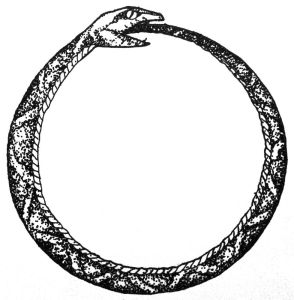
It’s the snake devouring its own tail picture. I did not know it was a real symbol, but apparently it is. (In occult stuff, as well as Viking culture. Weird.)

9eff4aa32768e751963a2221e13b98b0

I believe, given what I know of odd eastern mysticism, it would mean in that context that eternity flows in and out of itself, it feeds into itself, starting over and over again, regenerating, reincarnating.

Some cultures view time as cyclical, or traveling in a circle, which is why we have repeating patterns.

The biblical view of time is better represented by a wheel that rolls on a line, like the seraphs from Ezekiel’s vision, cycles repeat, but changes and alternations and progress still happen. Time is a vehicle getting us from one place to another. The only way a mortal being could travel without being burned up.

You’ll find the idea in “A Wrinkle in Time,” the 4th dimension is time, which is another way of saying the 3rd dimension is solid objects and the 4th is them moving. The 5th dimension is moving through time, or more accurately, moving time itself. Bending it.

That’s not really relevant to this, except as a concept slightly different from the repetition of the eastern view.  Even they think you reincarnate into better or worse states, as I said in my last post, all religion seems to share the idea of a better or worse end after death. In this case Karma is what decides that.

To be fair, I’m sure there’s nuance depending on whether you’re Hindu, Buddhist, or some other variation of a reincarnation-believing religion that I don’t know about because I live in the West. (Hey, it’s hard to keep track when you don’t live in it.)

But the point is, Thomas Sanders links this odd idea to the idea of losing motivation. He only applies it to creating his videos, but it easily applies to more than that. He actually sort of acknowledges this in other videos about “Why do we get up in the morning?” and “Learning New Things about Ourselves.” Even coming into the more lighthearted “Becoming a Cartoon.” He has a habit of getting existential.

Being the unashamed nerd that I am, I find his philosophy to be the most interesting part of his videos.

If you want to see for yourself, 6:00 minutes in is where the part that really interests me happens. I want to give credit where it’s due.


Patton (Morality) describes the creative process as a whole, mushy vision, and the solution to this is Logic. Yet Chesterton points out that a purely logical way of viewing things only narrows your perspective. The creative process may be unclear, but that mirrors how we see life, not always clear on what is happening, but able to see more because we cannot see all, than by trying to fit all into our logical minds.

That leads to a very dark, bleak, panic as Logic in this video discovers, being the solution to a problem he has caused. And those who try to see the world with reason alone find themselves in that  position, as Chesterton elaborates:

“Their position is quite reasonable; nay, in a sense it is infinitely reasonable, just as a threepenny bit is infinitely circular. But there is such a thing a mean infinity, a base and slavish eternity. It is amusing to notice that many of the moderns, whether skeptics or mystics, have taken as their sign a certain eastern symbol, which is the very symbol of this ultimate nullity. When they wish to represent eternity, they represent it by a serpent with his tail in his mouth. There is a startling sarcasm in the image of that very unsatisfactory meal. The eternity of the material fatalists, the eternity of the eastern pessimists, the eternity of the supercilious theosophists and higher scientists of to-day is, indeed, very well presented by a serpent eating his tail, a degraded animal who destroys himself.” (Orthodoxy, G. K. Chesterton. Pg 47.)

This got me to thinking about the anime I watch. I’ve noted this particular philosophy to be present in it. It’s a common one in anime, and other eastern influenced stuff, it’s also frequently found in the Church. It’s a common idea to men.

That you can, like with a piece of wood, whittle your character down into something beautiful and smooth.

katsuki-bakugou-my-hero-academic-4k-3o

My Hero Academia‘s eastern philosophy of lopping off all the bad habits and tenancies and honing your skills down to the basics. That you have a basically good nature, with potential, but you need to be trimmed, (it is literally expressed almost that exact way in Best Jeanist’s words to Katsuki Bakugo in Season 2.) It’s basically the same thing. And the same as the materialism which Chesterton is referring to, which by the way, he compares to madness.

The idea that materialism shuts out everything but just the material. It’s literally the definition, but the definition is awful, he thinks, because it is so narrow.

It may encompass the whole world in that it is a world view, but it also shuts out much of the world, anything that can’t be measured by matter. Including our emotions.

My Hero Academia is not that extreme. It certainly has a better worldview than materialism. It’s not completely wrong to think we should cut out the bad things of our lives.

The bible teaches that.

But here’s where it deviates, and I may add, where Thomas’s Logic has to cooperate with his Morality, since he is smart enough to know nullity is not the way:

The Bible says not just to remove evil, but to replace it with good. The idea is not to be some enlightened martial arts master, cut off from all negative emotions, inner peace is not the annihilation of troubling feelings, but the overcoming of them with better ones.

Few people can succeed at shutting off their feelings completely, even depression is a feeling, and those who can are only less able to understand them. But it’s far most possible to overcome our emotions by focusing on better things. OF course, we still deal with the bad stuff, but we do not dwell on it.

I could go for a long time about all the fictional examples of this, and even real life ones, but I think I can leave it here.

Good for you Sanders.

And Chesterton is a genius also.

Until Next Time–Natasha.


Why do opposites attract?

I’m back with another anime inspired post.

In all fairness, this is really more of an idea I’ve had for a long time, that anime just happens to highlight, as well as many other shows and books.

You ever wonder why opposites attract?

It’s something most people know, though some of us may not have experienced it, and it works with friends and family as well as romantic interests.

 Why is it a law of nature? It goes beyond magnetism. The whole world is full of opposites. The ground soaks up water, water is absorbed, they have opposite properties. Same with plants and sunlight, one receives, the other gives. We breathe in the oxygen that plants give out, they take in the carbon monoxide (or dioxide, I forget which is from breathing) that we give out.

The clear reason here is that there is a need, if everything was the same, it could not grow or multiply.

Now you take this to the relationship between a man and a woman, and it gets way more complicated.

I remember once starting that “Men are from Mars, Women are from Venus” book, but I couldn’t get into it, it was so stupidly simplistic. It attributed all the differences between men and women to superficial signs of those differences. What always happens with books/movies about this subject is the author ends up looking dumb because there are scores of women who start offering up examples of how they do not fit the model.

In their brilliant book Captivating, John and Stasi Eldredge begin the book about women with an acknowledgement that women can love anything from tea parties to hunting, dress up to canoeing, and that all this does not really make you feminine, but why you do those things might.

I am not going to go into all that, but I highly recommend the book, or searching for their talks on YouTube.

The real point I had was that they are realistic, they know you can’t put women into a box, or men for that matter. I just want to make it clear that this opposites attract thing is not solely about gender. Gender in the sense of hormones, sexual functions, and physical attributes that is; though they all play a small part.

But I mean in personality. Why do opposites attract?

The question is easier to understand when you realize that they don’t always, sometimes like forces do attract, many people prefer to hang around those with similar personalities. I don’t, generally, I don’t meet too many people like me; but sometimes I do and it’s kind of gratifying.

Which actually concerns me, because if I am only drawn to someone because they are like me, is that because it’s easier?

It’s not a secret that people round each other out. The Bible calls it “iron sharpens iron” and “two are better than one.” The Bible also says that the first two people were man and woman, by the way, so there is optimal companionship possible between the opposite genders.

Where this ties in to anime and other shows is in the shipping.

Mock me if you wish, but I persist in thinking that shipping basically reflect a person’s values where romantic relationships are concerned. I am only getting more convinced with time that what kind of fan you are is very telling about your character, but I can save that for another post. The point is, people who ship things for the wrong reasons, or who just don’t care, can take the same attitude toward real relationships.

I will not say there are never exceptions, but it’s the more common rule.

One of my favorite kinds of ships I’ve mentioned before are the opposites attract kind. But I recently got a new insight into how deep that goes.

Often people think opposites attract means your personalities have to be opposites. Two cheerful people won’t attract. Two serious people won’t. However, I find that untrue, in shipping and in life. Many couple are composed of two goofier, laid back people. Int hose cases, however, one person is always more so than the other, there is never complete similarity.

Where the opposite really is important is far more interesting, actually. It has to be in character flaws.

This sounds obvious, but it trips people up, let me tell you. Especially in real life, because honestly, it’s easier to see why two fictional people are too much alike than it is when complicated feelings are int eh way in the real world.

You can have two entirely different personalities, but have the same basic flaws.

And for an example here I am going to turn to the very popular My Hero Academia. (Sorry non-fans, but bear with me, I think you can still follow along.)

The three main characters of this show are Midoryia (better known as Deku), Todoroki, and Bakugo. I will spare you the long version of who they are, all that you need to know is that these three have entirely different personalities; yet the show/manga over time shows us that their basic character flaws can be oddly similar. Though Deku veers more to the lack of confidence in his abilities, and the other two veer more to lacking confidence int heir own characters, but all three end up feeling guilty for things they really shouldn’t; and heaping on the shame and self-loathing because of that. The way they express it is completely different for each. But even the other show characters note how similar they are at the core of the issue.

In the same way, people can have very different personalities, as men and women, and yet their insecurities, flaws, and foibles may be pretty much the same.

On the same show, Deku often gets paired up with Uraraka, a girl who has a similar personality, in that she’s sweet, and innocent.

A lot of people hate this ship simply because they seem so similar, but upon further consideration, I realized that they really aren’t. They might both be positive, and that is a good thing, but Uraraka does not live on Guilt Trip lane, nor does she often feel as disappointed with herself as Deku. She has her own flaws, but they are not the same as his, in some ways, they actually are opposites. Deku does not really like conflict, she thinks it is fun or impressive.

Anyway, I hope that made my point. You can apply this to any couple really. Look at your own parents for crying out loud. Mine are certainly total opposites in flaws, though they share many beliefs and values.

It is true that having opposite flaws often includes opposite personalities, but it does not have to.

And it is important to think about when you are dating someone, because in the end, you want to be with somebody who makes you better.

Did you know that humans have flawed cells in their body? Defective ones? And that it’s why you are not supposed to marry someone closely related to you? It’s because the chances that their defective cells will be the same as yours drastically increases, and that is why siblings marrying almost certainly causes defects, often mental ones, and cousins now, though it did not at one time. Over time as we get more defective cells it’s likely even 2nd and 3rd cousins will be too risky, but here’s the thing, it is far less of a risk if you marry someone not in your family. The risk is almost negotiable then, because it’s unlikely they will have enough of the same defective cells to give your kids problems.

There have been some exceptions, it can occasionally work out, and has in the past between more closely related family; and the problem was once not even there.

Theoretically, Adam and Eve were perfect, no defective cells, and for several generations, the amount of defective cells would have been too small to cause problems with intermarrying. That doesn’t even become wrong in the Bible until after Abraham’s time. Abraham married his half sister, and before you think that’s gross, it was common at that time and in other religions. Also, it did not cause any problems. But later on in the Bible it does become ore of an issue. However, 4,000 years or so ago, it was probably barely a risk.

This is a physical example of a spiritual truth if you think about it. Adam and Eve were without sin, so being exactly the same would not have hurt them. They did not have flaws, or imperfections, so how they matched up didn’t matter. It was only after sin that they develop both the same, and also different flaws, like cowardice, blame-shifting, and shame.

If sin was not a problem, we could all marry anyone we wanted, and not worry about making each other worse. As it is, if you do marry someone not good for you, it is still possible to make it work; it is just harder.

It is never the good qualities in ourselves that we need to worry about matching with. Two negative people should not get together, but two positive people can, it’s not a problem. Provided their positivism is not fake (which is really a flaw then.)

Anyway, I am not trying to start any weird idea that if you and your significant other have some of the same problems it means you can’t be together. I doubt anyone would listen to me anyway if I said that. We will always all be human, we all have insecurities, prejudices, and pride; but if we have different flavors of those things, we can help expose them to the light and make each other better.

That is the real difference to be concerned about, since at the end of the day, superficial stuff is not all that important.

Until Next Time–Natasha.


What’s Your Name?

“Who can give a man this, his own name?” –George MacDonald. (Unspoken Sermons.)

Hi, I’m back today with a much more mystical subject than I’ve been covering, (and by the way, mystical is not the same as mythical, mystical can be real, but very hard to understand unless you are a Mystic.)

What brought this on was recently watching the Anime Best Picture winner “Your Name.” I was both skeptical and hopeful when I heard about it, and so my siblings and I decided to try it out. We’ve only discovered we like anime over the last year or so, and we’ve been slowly trying different kinds. (I seem to like Slice of Life best aside from the shows I’ve gotten into.) I loved Koe no Katachi, a different anime movie, so I thought, what the heck?

And I thought Your Name was one of the most beautiful movies I’ve ever seen, from a visual and story perspective, though not without its flaws.

However this is not a movie review, watch it if you’re into that sort of thing, otherwise don’t bother, if anime turns you off. But the concept of the movie was something I did want to talk about, because part of what  I liked about it was how similar it was to other things I’ve read, and it’s mostly read, since I’ve seen few movies tackle the subject.

The movie centers around a couple different ideas which I’ll list here for clarity before breaking them down.

  1. The idea that Love transcends Time and Space
  2. The idea that there’s power in knowing someone’s Name.
  3. The idea that people are destined to meet, despite whatever impossible obstacles seem to stand in their way.
  4. The idea that time is interwoven, not just a long line of events.

The first two are the most important, and the ones I feel the most informed of, if you could call it that.

I happen to be a fan of Madeleine L’Engle’s first three books in the Wrinkle in Time series, my favorite out of the three is “A swiftly Tilting Planet,” it’s amazingly complex for such a short book, and it focuses on Joy, and Love, like all three of the books do, as well as Time Travel.

What’s interesting about it is that just like in “Your Name” the boy in this book time travels by going within someone else. Only it is several different people and all male. Also he other person’s conscious remains. he just blends into it, giving them help when he can but only subtly. they can’t know it’s him or it would scare them too badly. It is not possessive, but sharing, like a passing traveler.

The boy, Charles Wallace, goes within for the same reason Taki in the movie does, it is to redeem people and save others. There is a disaster int he book that is going to wipe out the world because of an evil man, and he has to redeem the parents of this man and save some of them also. Taki has only to save an entire town, but it proves just as difficult.

Interestingly, both stories share the theme of someone forgetting quickly as soon as they come out of it, what happened. Only, instead of Charles Wallace forgetting, it’s Meg who is only helping him by a sort of telepathic connection they have (more spiritual than mental) and because she is not there, it fades from her mind. Like a dream. Other characters in the book have dreams that are actually from Charles Wallace’s life, while he is within them.

I find the similarities astounding.

Here we have the idea that lives can be shared across time and space, and it is because of love, joy, and the need for salvation (in every sense of the word) that it happens. We have the idea that our spirits are not bound by time, space, or our minds. Because Meg’s mind may not be able to retain it (her brother has a rare mind that is able to, not many people do) but her heart and spirit can. In the movie, the two people’s minds are only able to remember for a short time what happens, but their hearts and souls remember always.

It’s actually a common idea in Japan that people can be connected and share sorrows and joys, especially with lovers. And the idea is actually not unbiblical. I’ve heard stories of people sharing feelings or some other kind of connection in the spirit, or even physical pain.

But and even more important thing (at least for the average person who probably won’t expereince that kind of trascendential existance in this life) is the second thme. The power of names.

I again turned to L’Engle, this time her second book int he series, A Wind in The Door. In this book Meg learns more about her task in the universe (in Church we would call it spiritual gifting or calling, the secular world also calls it a calling, rather mockingly, but also with some seriousness.) It is to be a Namer, and she does not get it. She asks her teacher about it:

Meg: “Well, then, if I’m a Namer, what does that mean? What does a Namer do?”

Proginoskes: “When I was memorizing the names of the stars, part of the purpose was to help them each to be more particularly the particular star each one was supposed to be. That’s basically a Namer’s job. Maybe you’re supposed to make earthlings feel more human.”

He goes on to explain that their enenmies, the Echthroi, are trying to destroy the world by doing just the opposite:

“I think your mythology would call them fallen angels. War and hate are their business, and one of their chief weapons is un-Naming – making people not know who they are. If someone knows who he is, really knows, then he doesn’t need to hate. That’s why we still need Namers, because there are places throughout the universe like your planet Earth. When everyone is really and truly Named, then the Echthroi will be vanquished.”

In “Your Name” the problem is not that the characters forget who they are, but that they forget each other, every time the barrier of time is reinstated between them, they forget. And eventually forget even that there was a person they were trying to remember. Though they have a vague idea that they are always searching for someone or somewhere or something. Because they cannot remember the name they don’t know who each other are. It echoes L’Engle’s idea so closely, it’s bizarre.

Knowing your own name is important, so is knowing other people’s. But why?

George MacDonald had some very profound thoughts about this, in his Unspoken sermon about names he notes that the names we give each other are just shadows of what a real name is, since the real name, that God will give us at the end of time, is one only he and we will know, and only that one person will have.

“The true name is one which expresses the character, the nature, the being, the meaning of the person who bears it. It is the man’s own symbol,–his soul’s picture, in a word,–the sign which belongs to him and to no one else. Who can give a man this, his own name? God alone. For no one but God sees what the man is, or even, seeing what he is, could express in a name-word the sum and harmony of what he sees.” 

(Link to the full sermon here: http://www.online-literature.com/george-macdonald/unspoken-sermons/5/)

Taki and Mitsuha are not names that sum up who they are exactly.

Mitsuha means “third leaf” and is similar to her grandmother’s, mother’s and sister’s names, which are first leaf, second leaf, and fourth leaf, in that order. It symbolizes he place in the story as a carrier on of tradition, but not her personality.

Taki means waterfall or water plunging. He does plunge into water in a sort of vision in the movie, and that is when he is able to save Mitsuha and her village by switching with her one last time. But it doesn’t sum him up.

In the end, that’s not really the point. The names in the movie do just what MacDonald points out our human names for each other are meant to do, identify us to ourselves. Help us distinguish each other, honor each other, and of course, remember who is who.

But as MacDonald and L’Engle both point out, there’s a higher reason for names. Names carry our identity.

My full name (which I don’t use on this blog and won’t actually give here for privacy reasons) mean “joy/rejoicing, Christ’s Birthday, and guardian/one who guards or protects.” If you knew me in real life, it makes sense. Even on this blog, it makes sense.

I’ve been told many times my name was no accident. Not everyone is blessed with a good name. In India many girls are cursed with a name that means “unwanted” there’s a group that takes in some of these girls and allows them to legally change their name into something better. If your name has absolute no positive connotations, I’d suggest you consider going by something else, but most names do have some good meaning.

Why is it important?

It might surprise you.

In the Bible a lot of stress is put on names, I’d say more than almost any other religion. Names are seen as so powerful that priests could not even write the full name of God because it was so holy, they abbreviated it to “Yah.” The bible doesn’t actually say not to write God’s name, that I know of, it’s more of a Hebrew culture thing added later, but that is how seriously they take it.

The second commandment is not to misuse the name of God. Sadly, even Christian often don’t take this one seriously.

But even so, other names have power. Abigail’s husband Naboth, who disrespected King David, name means fool. Sometimes bible names come to mean that thing because of the bearer (I think Ruth is like this, it mean friend), but Abigail tells David he is just as his name suggests, meaning it already meant that and his parents clearly sucked.

Judah means “praise,” and David was of the tribe of Judah, as was his son Solomon, both of whom wrote psalms and considered worship to be very important.

Jesus means “deliverer”, Emmanuel means “God with us.”

The list goes on and on and on, any important Bible figure almost always has a name that connects to their purpose. Noah means “rest or peace”, Jacob means “usurper”, Moses means “drawn out”, and if you know their stories, it all makes sense.

But even more importantly God himself tells us names are important.

Phil 2:9 “Therefore God has also highly exalted Him and given Him the name which is above every name.”

In Exodus 3:15, He tells Moses his name is I Am Who I Am (Yahweh) “This is My name forever.”

Google verses about names if you want an even more in depth list, but even this tells us names can be eternal, and higher, and powerful. Names mean authority.

Heck, everyone knows this, think of even a couple hundred years ago when black people had “slave names”, names usually not in proper English, that they would change when they were freed or they would finally get a last name like a legal citizen would have. Changing the name was a sign of being able to be though of as an intelligent human being. Even before they really were, by most people.

Even in fiction, every writer knows, names are important. My character’s names always come to me, and then unless I use them, no other name will stick in my head. After awhile I started looking up the names when this happened and was shocked to discover that (at least when they were real and not made up ones) each name had a meaning that matched the purpose I had for the character, and something about their personality too.

Even when we don’t know a meaning, a name has immense power. There’s a whole cultist idea about this, but let me say, names don’t dictate everything. They help, sure, but you still choose what you do with your name. So don’t worry about it if your name has a personality associated with it that you don’t like. (I prefer not to look into that stuff at all, I stumbled on some by accident. It was scarily accurate in some ways, but wrong in others. No one can fully predict who you will be except God.)

Well, this ran long because of all the quotes, but it was interesting. I hope it inspired you to go look up what your name means, it might surprise you. And until next time–Natasha (Christ’s Birthday.)